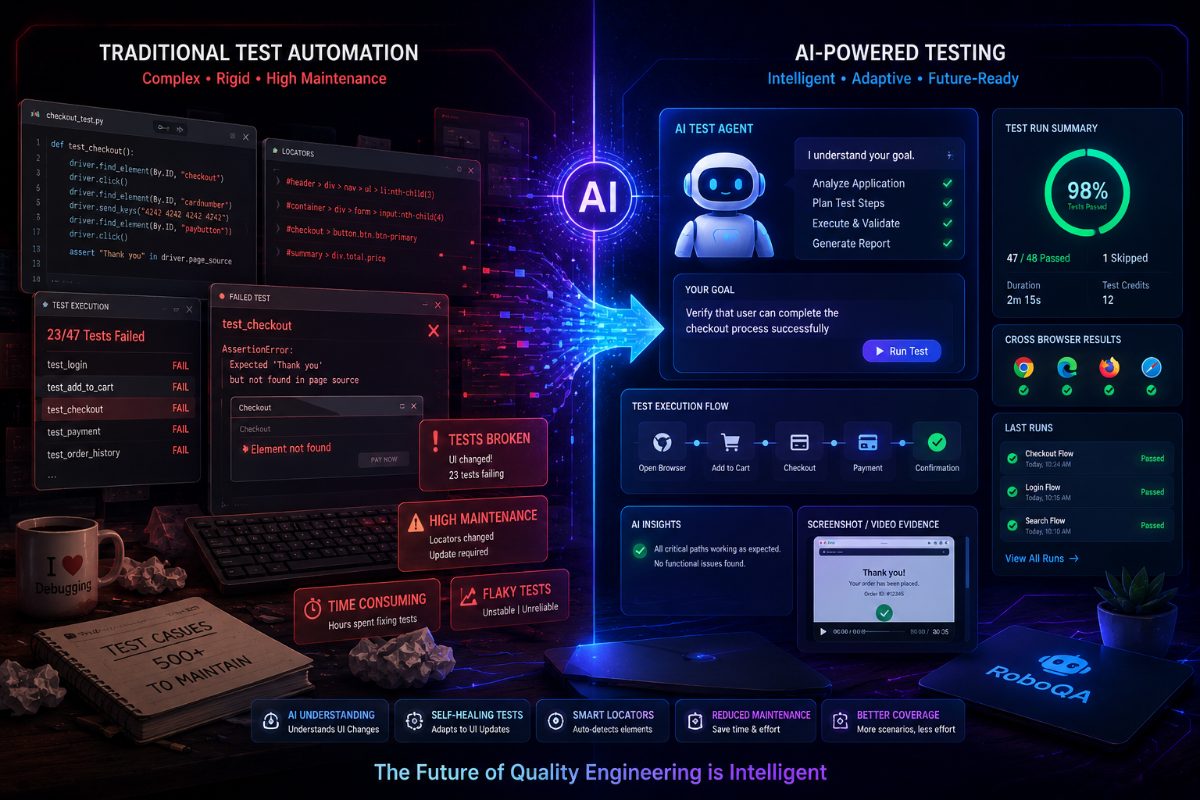
Why Traditional Test Automation Is Breaking Under Modern Software Complexity
Software development has changed dramatically.
Applications are released faster.
User expectations are higher.
Teams are building more complex digital experiences.
Testing has become more important than ever.
For years, automation helped QA teams keep up with increasing demands.
Engineers created scripts.
Automation frameworks executed workflows.
Regression testing became faster.
But modern software has introduced a new challenge:
Traditional automation is becoming harder to maintain.
The problem is not that automation does not work.
The problem is that applications have become too dynamic for older approaches alone.
---
The Evolution Of Test Automation
A decade ago, many applications were simpler.
Testing a website often meant checking:
- Basic pages
- Forms
- Navigation
- Simple user workflows
Automation was straightforward.
A tester created a script.
The script performed actions.
The system verified results.
Tools like Selenium changed software testing by making browser automation accessible.
Thousands of teams adopted automation.
But software continued evolving.
---
Modern Applications Are More Complex
Today's applications are not static websites.
They include:
- Dynamic user interfaces
- Single-page applications
- Multiple devices
- Different browsers
- Personalised experiences
- Complex customer journeys
A user may interact with a product through:
- Desktop browser
- Mobile browser
- Different operating systems
- Different screen sizes
Testing every possible experience is becoming increasingly difficult.
---
The Hidden Cost Of Automation Maintenance
Most teams understand the value of automation.
The challenge comes after implementation.
Automation requires maintenance.
A small product change can create problems.
Examples:
A button changes location.
A component is redesigned.
A page structure changes.
A new step is added to a workflow.
The application may work perfectly.
But the automation fails.
QA teams then spend time fixing scripts instead of improving coverage.
---
When Automation Becomes Another Product To Maintain
Many organisations eventually discover something surprising:
Their automation framework itself requires significant engineering effort.
Teams need to manage:
- Test scripts
- Framework updates
- Dependencies
- Failed executions
- Flaky tests
- Environment issues
Instead of reducing workload, poorly maintained automation can create additional complexity.
---
The Difference Between Actions And Intent
Traditional automation understands actions.
Example:
Click button.
Enter text.
Select option.
Verify element.
But humans think differently.
A QA engineer does not think:
"Click the blue button at this location."
They think:
"Can a customer successfully complete checkout?"
The real goal is not the click.
The real goal is validating the user experience.
This is where AI-powered testing introduces a new approach.
---
How AI Testing Changes Automation
AI testing focuses more on intent.
Instead of writing every individual step, teams can describe what they want to validate.
Examples:
"Test user registration."
"Verify customers can complete payment."
"Check if navigation works correctly."
The AI agent can understand the workflow, interact with the application, and provide results.
---
AI Testing Does Not Replace Traditional Automation
Traditional automation is still valuable.
Frameworks like Selenium and Playwright remain useful for many scenarios.
They provide:
- Control
- Reliability
- Customisation
- Deep technical integration
AI testing adds another layer.
It helps with areas where traditional automation becomes difficult:
- Changing interfaces
- Exploratory workflows
- Regression testing
- User journey validation
The future is not one technology replacing another.
The future is combining multiple approaches.
---
The New Role Of QA Engineers
AI is changing what QA engineers spend their time doing.
Less time on:
- Repeating manual checks
- Fixing simple automation failures
- Maintaining large script libraries
More time on:
- Understanding risks
- Designing better test strategies
- Improving customer experience
- Finding important defects
The value of QA is not clicking buttons.
The value is understanding quality.
---
How RoboQA Helps Modern QA Teams
RoboQA is built around the idea that testing should be easier and more accessible.
Instead of creating complex browser automation scripts, teams can describe testing scenarios naturally.
Examples:
"Verify login functionality."
"Test checkout after applying a discount."
"Check website navigation across user journeys."
RoboQA's AI-powered testing workflow helps teams execute browser tests and generate useful results.
---
The Future Of Software Quality
The next generation of testing will not be about writing more scripts.
It will be about creating smarter testing systems.
Successful teams will combine:
Human expertise.
Traditional automation.
AI-powered testing agents.
Together, these approaches can help companies deliver reliable software faster.
---
Final Thoughts
Automation changed software testing.
But software itself has changed.
Modern applications require testing approaches that are faster, more adaptive, and easier to maintain.
AI testing represents the next step in this evolution.
The goal is not replacing automation.
The goal is building better automation.
RoboQA CTA
RoboQA helps teams test web applications using AI-powered browser automation.
Describe your testing scenario, let AI execute the workflow, and receive actionable testing insights.
Build faster, smarter, and more reliable software with RoboQA.