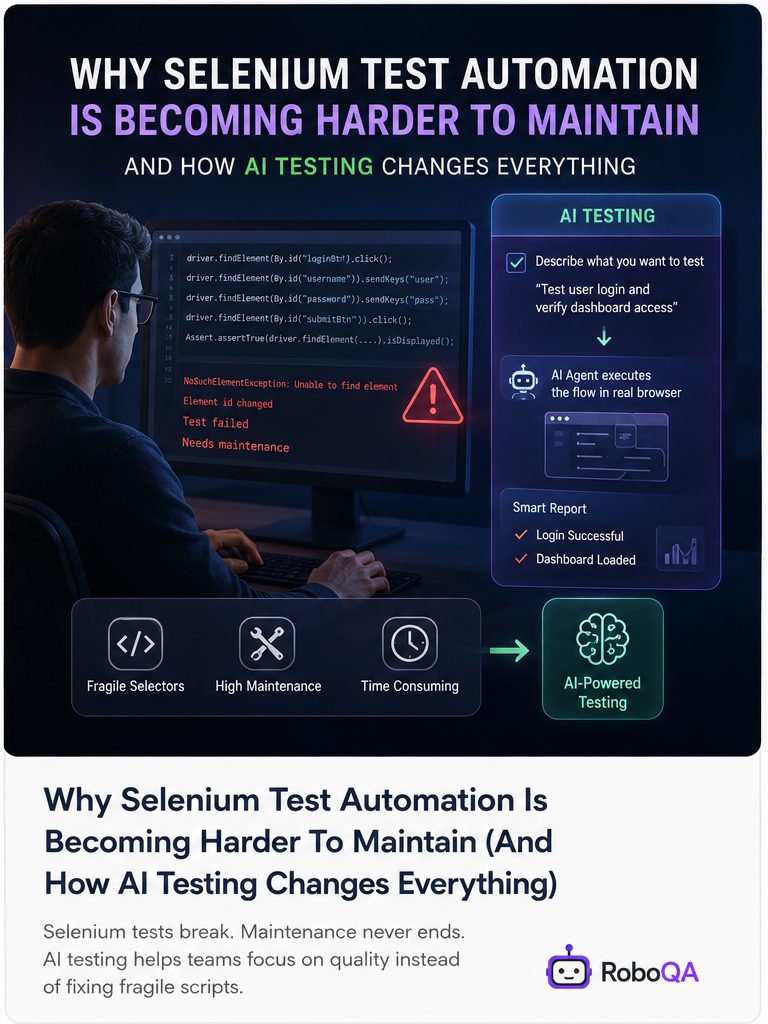
Why Selenium Test Automation Is Becoming Harder To Maintain
For years, Selenium was the foundation of web automation.
When teams wanted to automate browser testing, Selenium was usually the first choice.
And it deserved that position.
Selenium helped thousands of teams move from manual testing to automated regression testing.
But software development has changed.
Modern applications are no longer simple websites.
They are dynamic platforms with:
- Constant UI changes
- Multiple browsers
- Responsive layouts
- Complex user journeys
- Faster release cycles
The biggest challenge today is not creating automation.
It is maintaining automation.
---
The First Automation Tests Always Feel Amazing
The beginning of automation is exciting.
A QA engineer creates a few scripts.
Login works.
Checkout works.
Forms are validated.
Regression runs automatically.
The team saves hours.
But as the product grows, something changes.
The number of tests grows.
The UI changes.
The application becomes more complex.
And maintenance starts becoming the real challenge.
---
Small Changes Create Big Automation Problems
A developer changes a button.
A designer updates a form.
A component gets redesigned.
For users, these changes improve the product.
For traditional automation, they can create failures.
A single UI update can break multiple tests because automation depends heavily on:
- Selectors
- XPath
- Element IDs
- Page structure
- Fixed workflows
Now the QA team spends time repairing automation instead of improving coverage.
---
The Hidden Cost Of Test Maintenance
Most teams measure the value of automation by asking:
"How many tests have we automated?"
A better question is:
"How much time are we spending maintaining those tests?"
A large automation suite can become another software project.
It needs:
- Updates
- Debugging
- Ownership
- Continuous maintenance
Automation should reduce repetitive work.
It should not create another backlog.
---
Why Teams Are Exploring AI Testing
AI-powered testing introduces a different approach.
Instead of explaining every technical step, teams describe the expected behaviour.
Traditional automation:
"Click this button with this selector."
AI testing:
"Verify that users can successfully complete checkout."
The focus moves from technical instructions to user goals.
---
AI Testing Reduces The Maintenance Burden
With AI-powered browser testing, teams can describe workflows in natural language.
Examples:
"Test user registration and verify successful account creation."
"Check checkout flow and validate payment confirmation."
"Verify that users can update their profile information."
The AI agent executes the workflow and reports the result.
---
AI Does Not Replace QA Engineers
AI testing is not about replacing testers.
Experienced QA engineers are still responsible for:
- Risk analysis
- Exploratory testing
- Understanding business impact
- Investigating failures
- Making release decisions
AI removes repetitive execution.
Humans provide judgement.
---
The Future Of Web Automation
The future of testing is not:
Manual testing vs Automation.
The future is:
Human expertise + intelligent automation.
The best QA teams will use AI to remove repetitive tasks and spend more time improving product quality.
---
Final Thoughts
Selenium changed software testing forever.
But as applications become more complex, testing approaches must evolve.
The next generation of QA will not be about writing more scripts.
It will be about creating smarter testing systems.
CTA
RoboQA helps teams test websites using natural language instead of maintaining hundreds of fragile automation scripts.
Describe your workflow. Let AI test it.