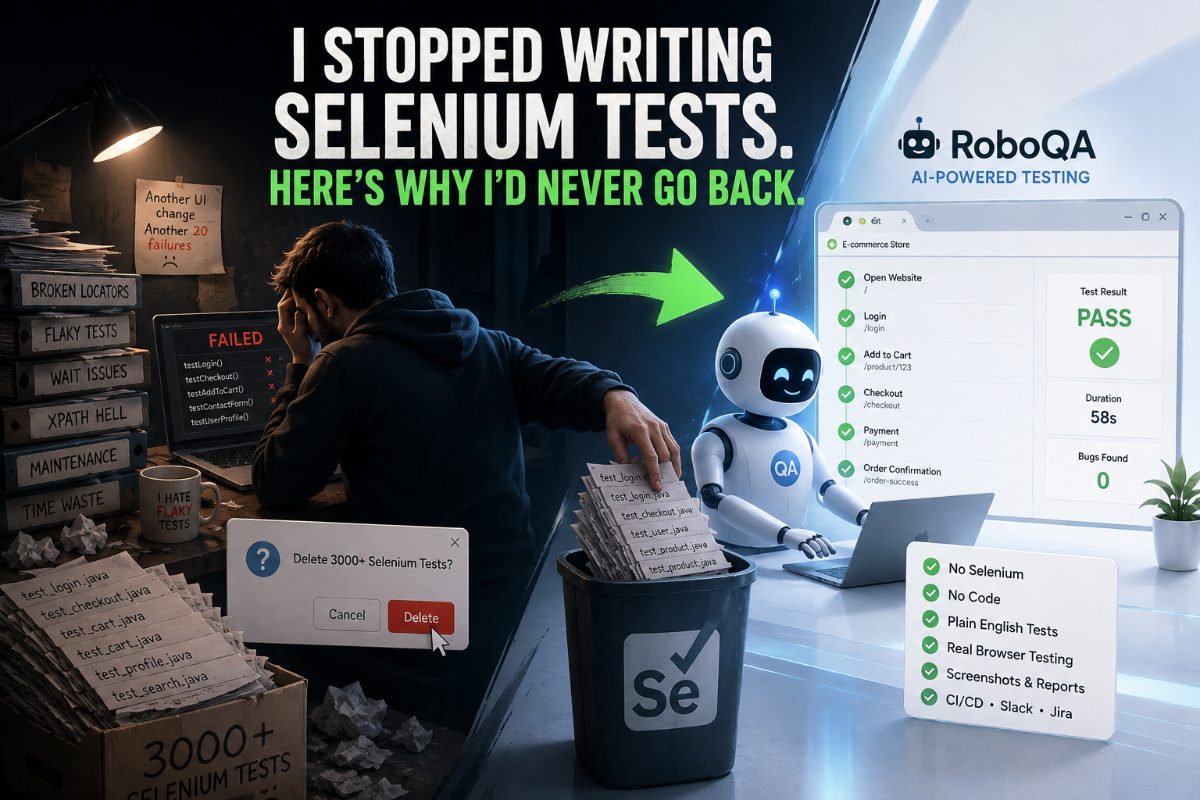
I Stopped Writing Selenium Tests. Here's Why I'd Never Go Back.
Every QA engineer remembers their first automation project.
Mine felt incredible.
I wasn't clicking through login pages anymore.
I wasn't testing the same checkout flow every Friday.
I wasn't spending entire afternoons checking whether a contact form still worked.
Instead, I was writing Selenium tests.
It felt like freedom.
Every automated test meant less manual work.
Or so I thought.
A year later, I wasn't maintaining the application anymore.
I was maintaining the automation.
---
Automation Didn't Eliminate Work. It Moved It.
Most people compare manual testing with automation.
Very few compare automation with automation maintenance.
That's where the real cost appears.
A developer changes the HTML.
A designer renames a button.
Someone wraps a component inside another div.
Nothing is broken for the customer.
But suddenly...
Twenty Selenium tests fail.
Not because your product is broken.
Because your selectors are.
Now someone has to investigate.
Update the locator.
Run the suite again.
Repeat.
Across hundreds—or thousands—of tests, those "small fixes" quietly consume weeks of engineering time every year.
---
Software Changed. Testing Didn't.
Selenium was built for an era when software shipped every few months.
Today's software ships every day.
Sometimes several times a day.
Modern products constantly evolve.
- New UI components
- Feature flags
- Responsive layouts
- A/B experiments
- Dynamic content
- AI-generated interfaces
Every release changes something.
Your automation has to change with it.
Eventually the automation becomes almost as complex as the application itself.
That's when teams begin asking the wrong question.
"Why are the tests failing?"
Instead of
"Is the product actually broken?"
---
The Hidden Cost Nobody Budgets For
Let's imagine a team with 1,500 UI tests.
Every sprint they spend:
- Updating selectors
- Investigating flaky failures
- Waiting for reruns
- Debugging timing issues
- Fixing broken scripts
None of that improves the product.
None of that creates customer value.
It's simply the cost of keeping the automation alive.
And because it happens gradually, most companies never realise how much engineering capacity they're losing.
---
The Real Goal Was Never Automation
Nobody wakes up wanting more Selenium tests.
Teams want confidence.
They want to deploy on Friday afternoon without worrying about Monday morning.
They want to know:
- Can customers still log in?
- Does checkout still work?
- Did the latest deployment break mobile?
- Are forms still submitting?
- Can users complete the critical journey?
Automation isn't the goal.
Confidence is.
---
Then AI Changed The Conversation
Large Language Models introduced something different.
Instead of teaching software exactly where every button lives...
...we can describe what success looks like.
For example:
Verify a customer can complete checkout.
Or
Test the login flow using saved credentials.
Or
Ensure the contact form validates required fields correctly.
Instead of writing hundreds of lines of automation code...
You're describing user behaviour.
That's a fundamental shift.
You're defining intent.
Not implementation.
---
That's Why I Built RoboQA
After years working in QA and software testing, I realised something.
The hardest part of automation isn't writing tests.
It's maintaining them.
So I asked myself a different question.
"What if testing worked more like talking to another QA engineer?"
Instead of writing code...
You simply describe what you want tested.
For example:
"Verify checkout works from product page to payment confirmation."
"Test login using saved credentials."
"Check the mobile navigation on the homepage."
RoboQA launches a real browser.
Completes the journey.
Captures screenshots.
Detects bugs.
Produces a detailed report.
Usually in under a minute.
No Selenium.
No Playwright.
No brittle selectors.
No XPath.
Just tell RoboQA what should work.
---
Does This Mean Selenium Is Obsolete?
No.
And anyone telling you otherwise probably hasn't worked on enterprise software.
Selenium remains an excellent framework.
Especially when you need:
- Highly customised automation
- Legacy enterprise systems
- Complex backend integrations
- Long-term automation projects
This isn't about replacing Selenium.
It's about recognising that many testing problems no longer require script-based automation.
Website regression testing.
User journeys.
Smoke tests.
Accessibility checks.
Release validation.
These can often be described in plain English.
And that's where AI changes everything.
---
The Bigger Shift Happening In QA
For years we've asked engineers to explain software to machines.
Now machines are finally capable of understanding engineers.
That's a profound change.
Instead of writing automation code...
QA teams define expectations.
AI performs the repetitive work.
Engineers investigate what actually matters.
The result isn't fewer QA engineers.
It's better QA engineers.
People solving problems instead of maintaining scripts.
---
Before Your Next Release...
Ask yourself one question.
How much time does your team spend finding bugs...
...and how much time do they spend maintaining the tools that are supposed to find them?
If those numbers are getting closer every sprint...
Maybe the problem isn't your QA team.
Maybe it's your testing workflow.
---
Ready To Test Differently?
If your team is tired of maintaining Selenium scripts, RoboQA offers another approach.
Describe what you want to test in plain English.
RoboQA opens a real browser, performs the user journey, detects bugs, captures screenshots, and generates detailed reports automatically.
Less scripting.
Less maintenance.
More confidence before every release.
Try RoboQA and see how much testing you can automate without writing another Selenium script.