Why Teams Are Looking For Selenium Alternatives In 2026
Selenium changed software testing forever.
For many years, it was the default choice for browser automation.
Thousands of QA teams built frameworks around it.
Millions of automated tests were created.
But software development has changed.
Applications are released faster.
User interfaces change more frequently.
Teams are expected to test more platforms with fewer resources.
And this has created a new question:
Is traditional browser automation still enough?
---
Selenium Solved Yesterday's Problem
Selenium was designed for a world where automation meant:
Write code.
Control the browser.
Find elements.
Execute actions.
Validate results.
This approach works.
But it requires continuous maintenance.
Every change in the application can affect automation.
A renamed button.
A redesigned checkout page.
A changed form structure.
A new user journey.
The automation needs updates.
---
The Hidden Cost Of Script-Based Automation
The biggest challenge with Selenium is not writing the first test.
The challenge is maintaining hundreds or thousands of tests.
QA teams spend significant time on:
- Fixing broken selectors
- Updating scripts after UI changes
- Managing test frameworks
- Debugging flaky failures
Eventually, automation itself becomes another application that needs maintenance.
---
Modern Applications Need Modern Testing
Today's products are different.
A website may need validation across:
- Chrome
- Firefox
- Edge
- Safari
- Desktop
- Mobile devices
- Different user journeys
Manual testing cannot scale.
Traditional scripts become expensive to maintain.
Teams need a smarter approach.
---
The Rise Of AI Testing
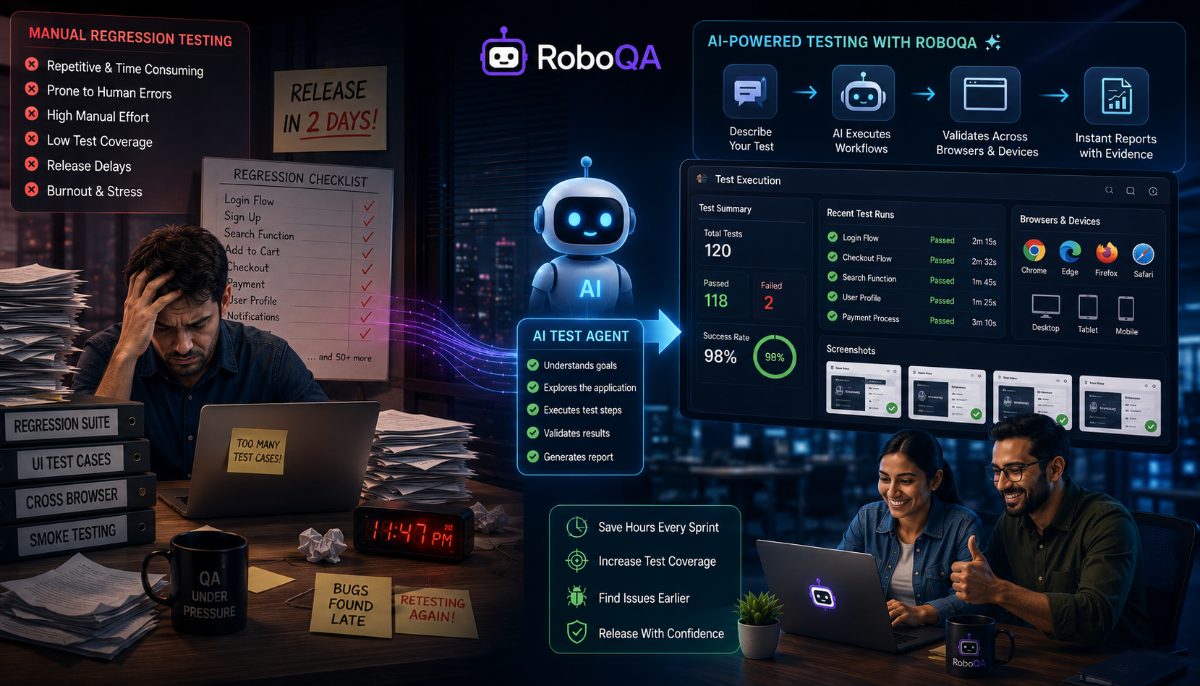
AI-powered testing changes the relationship between humans and automation.
Instead of telling the system exactly:
"Click this button with this selector."
Teams can describe:
"Test the checkout experience and verify customers can complete payment."
The AI agent understands the workflow.
It interacts with the application.
It observes behaviour.
It reports results.
---
AI Testing Does Not Replace Selenium Everywhere
Selenium remains useful.
There are situations where traditional automation frameworks are the right choice.
But many teams are adding AI testing for areas where scripts create unnecessary maintenance:
- Regression testing
- UI validation
- User journeys
- Exploratory workflows
The future is not one tool replacing another.
The future is choosing the right tool for the right problem.
---
How RoboQA Approaches Browser Testing
RoboQA focuses on reducing the effort required to automate browser testing.
Teams describe what they want to verify.
The AI agent executes the workflow.
The system generates results with evidence.
This helps teams test faster without creating large automation frameworks for every project.
---
The Next Generation Of QA Automation
The biggest change in testing is moving from:
"Automation that follows instructions."
to:
"Automation that understands goals."
QA engineers will continue to provide the most important part:
Quality judgement.
AI simply removes repetitive execution.
---
Final Thoughts
Selenium created the foundation of browser automation.
AI testing is building the next layer.
For teams struggling with increasing regression workload, faster release cycles, and growing applications, exploring AI-powered testing is becoming a practical next step.
RoboQA CTA
RoboQA helps teams test websites using AI-powered browser automation.
Describe your test scenario and let AI execute the workflow.