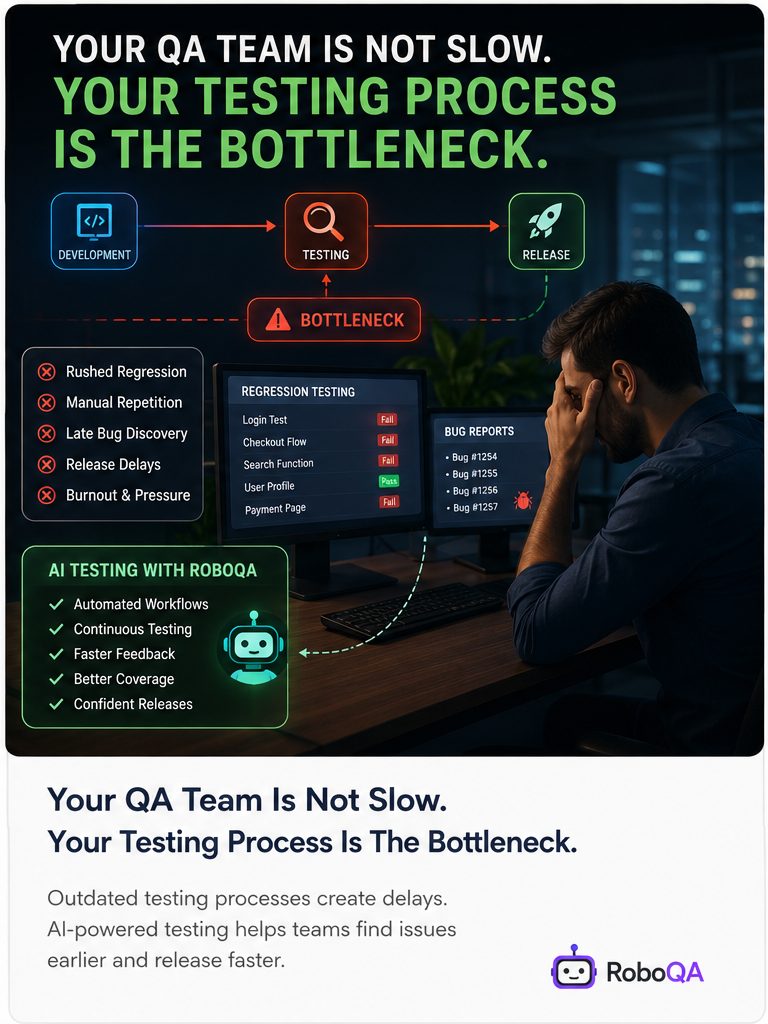
Your QA Team Is Not Slow. Your Testing Process Is The Bottleneck
Every software team knows this situation.
A release is approaching.
Developers have completed features.
Product teams are waiting.
Customers are expecting updates.
Then testing begins.
Suddenly everything slows down.
Regression starts.
Bugs appear.
Fixes are created.
Retesting begins.
And QA gets blamed for delaying the release.
But the real problem is usually not the QA team.
The problem is the process.
---
Testing At The End Creates Pressure
Many organisations still follow this pattern:
Development → QA → Release
The problem is that QA receives all the changes at the final stage.
Imagine testing two weeks of development work in two days.
The QA engineer has to verify:
- New features
- Existing workflows
- Multiple browsers
- Mobile layouts
- Edge cases
The available time is limited.
Something will always be missed.
---
Adding More Testers Does Not Fix Everything
Increasing team size can help.
But it does not solve the fundamental problem.
The process is still based on humans manually executing repetitive checks.
Someone still has to:
- Open browsers
- Follow workflows
- Verify screens
- Capture screenshots
- Repeat the same tests
The workload keeps growing.
---
Modern Teams Are Moving Towards Continuous Testing
High-performing teams are changing their approach.
Instead of waiting until release:
They test throughout development.
Instead of manually repeating every workflow:
They automate repetitive checks.
Instead of maintaining thousands of scripts:
They use intelligent testing tools.
---
How AI Testing Helps
AI-powered testing allows teams to describe what they want to verify.
For example:
"Test the signup process. Verify validation messages and confirm users can successfully create an account."
The AI agent executes the workflow.
It checks the experience.
It creates a report.
Teams receive feedback earlier.
---
QA Becomes More Valuable
When repetitive testing is automated, QA engineers can focus on higher-value activities.
They can spend more time on:
- Finding hidden risks
- Improving test strategy
- Exploring new features
- Understanding customer behaviour
The role of QA becomes stronger, not smaller.
---
Quality Should Not Be A Final Checkpoint
The best software teams don't test only before release.
They build quality into the entire development process.
Earlier feedback means:
- Faster fixes
- Better releases
- Less production risk
---
Final Thoughts
QA teams are not slow.
Most teams are simply using processes designed for a slower software world.
As development becomes faster, testing must become smarter.
AI-powered testing gives teams a way to increase coverage without increasing manual effort.
CTA
RoboQA helps modern software teams automate browser testing using plain English and AI-powered workflows.