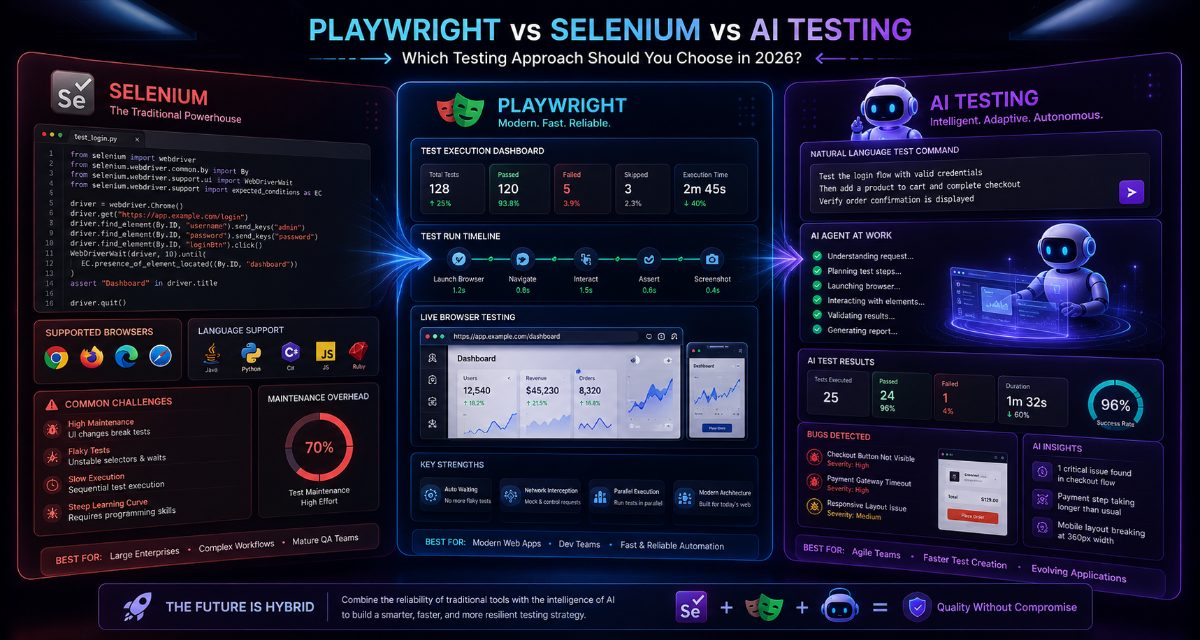
Playwright vs Selenium vs AI Testing: Which Testing Approach Should You Choose in 2026?
Software testing has evolved dramatically over the last decade.
Teams once relied almost entirely on manual testing.
Then browser automation frameworks like Selenium became the standard.
More recently, Playwright has gained popularity for modern web applications.
Now, AI-powered testing is introducing another way to automate software quality.
The question many engineering teams ask today is:
Which approach should we choose?
The answer depends on your application, your team, and your testing goals.
Let's compare all three.
---
Selenium: The Foundation of Browser Automation
Selenium has been the industry standard for browser automation for many years.
It gives engineers complete control over browser interactions.
Typical Selenium workflow:
- Launch browser
- Find web elements
- Perform actions
- Validate results
Strengths
- Mature ecosystem
- Large community
- Supports multiple programming languages
- Cross-browser compatibility
- Strong CI/CD integrations
Challenges
- Requires coding skills
- Script maintenance can become expensive
- UI changes frequently break tests
- Framework setup takes time
Selenium remains an excellent choice for large automation frameworks.
---
Playwright: Built for Modern Web Applications
Playwright was designed to solve many limitations of traditional browser automation.
It supports modern JavaScript applications and provides reliable browser control.
Playwright includes features like:
- Auto waiting
- Network interception
- Multiple browser contexts
- Better handling of dynamic web pages
Strengths
- Fast execution
- Modern architecture
- Better stability
- Excellent developer experience
- Strong support for modern web frameworks
Challenges
- Still requires coding
- Teams need automation expertise
- Test maintenance remains necessary
- Less mature ecosystem compared to Selenium
For many development teams, Playwright has become the preferred automation framework.
---
AI Testing: A New Approach
AI testing changes the way automation is created.
Instead of writing detailed browser scripts, testers describe the outcome they want.
Examples:
"Verify user registration."
"Test checkout."
"Validate search functionality."
The AI agent performs the browser actions and analyzes the results.
Instead of focusing on scripts, the focus shifts to user behavior.
---
Comparing The Three Approaches
Selenium
Best for:
- Large enterprise automation
- Long-established frameworks
- Highly customized automation
Requires:
- Programming knowledge
- Framework maintenance
- Continuous script updates
---
Playwright
Best for:
- Modern web applications
- JavaScript-heavy websites
- Fast browser automation
Requires:
- Coding skills
- Test maintenance
- Framework knowledge
---
AI Testing
Best for:
- Fast browser testing
- User journey validation
- Regression testing
- No-code or low-code automation
- Teams wanting faster automation adoption
Requires:
- Well-defined testing goals
- Evaluation of AI-generated results
---
Which Tool Is Right For Your Team?
There isn't one perfect answer.
Choose Selenium if:
- You already have a mature automation framework.
- Your engineers are experienced with Selenium.
- Your workflows are stable.
Choose Playwright if:
- You're building modern web applications.
- Your developers prefer JavaScript or TypeScript.
- You want faster browser automation.
Choose AI testing if:
- You want to reduce script maintenance.
- You need faster test creation.
- Your UI changes frequently.
- Your QA team wants to focus on quality instead of writing automation code.
---
The Future Is Hybrid Testing
Many successful engineering teams won't choose only one solution.
Instead, they'll combine approaches.
For example:
- Selenium for legacy systems.
- Playwright for modern web applications.
- AI testing for user journeys and regression validation.
Each tool solves a different problem.
---
How RoboQA Fits Into Modern Testing
RoboQA is designed to simplify browser testing with AI.
Instead of spending hours writing and maintaining scripts, teams describe what they want to verify.
Examples:
- Verify login.
- Test checkout.
- Validate responsive layouts.
- Check navigation.
- Test registration.
The AI agent performs browser testing, captures evidence, and generates detailed reports.
This allows engineering teams to increase testing coverage while reducing repetitive work.
---
Final Thoughts
Selenium transformed browser automation.
Playwright modernized it.
AI testing is making automation more intelligent.
The future isn't about replacing one tool with another.
It's about choosing the right combination to build faster, smarter, and more reliable software.
RoboQA CTA
Modern software testing doesn't have to rely on endless scripts.
With RoboQA, describe your testing goals in plain language and let AI execute browser workflows, identify bugs, and generate detailed reports.
Build faster. Test smarter. Release with confidence.