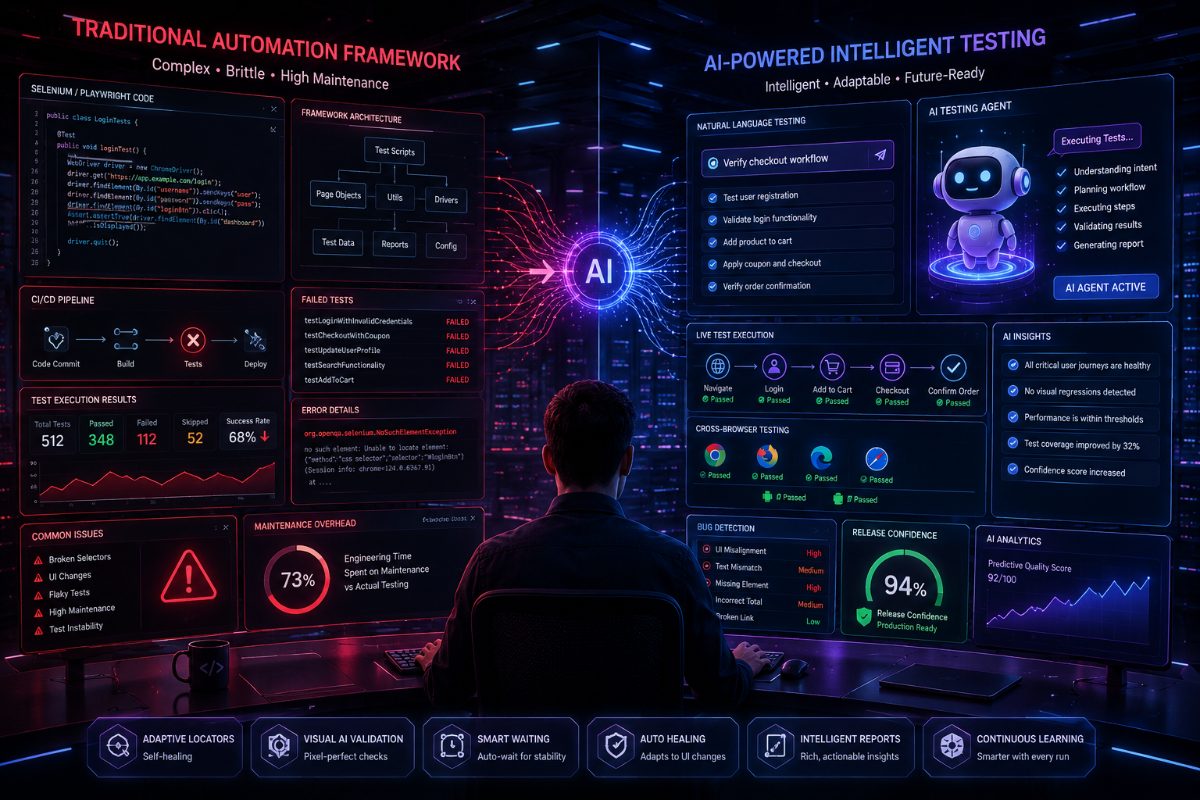
How to Build a Modern Test Automation Framework in 2026 (Without Creating a Maintenance Nightmare)
Ask almost any automation engineer about their biggest challenge, and the answer usually isn't writing tests.
It's maintaining them.
Every QA team starts with good intentions.
A clean automation framework.
Reusable components.
Well-organized test suites.
Clear reporting.
Reliable execution.
Fast feedback.
But as products grow, releases become more frequent, and user interfaces evolve, many frameworks slowly become difficult to maintain.
The framework that once accelerated releases starts demanding its own engineering effort.
So how should teams build automation frameworks in 2026?
More importantly…
Can AI reduce the maintenance burden entirely?
Let's explore.
---
Why Every QA Team Needs a Framework
Writing individual automation scripts quickly becomes unmanageable.
A framework provides structure.
Instead of hundreds of disconnected test files, teams organize automation around reusable components.
Good frameworks provide:
- Shared utilities
- Common browser setup
- Reusable page objects
- Reporting
- Logging
- Test data management
- CI/CD integration
Without a framework, automation becomes difficult to scale.
---
The Biggest Mistake Teams Make
Many teams build frameworks for today's application.
Not tomorrow's.
Applications change.
UI components evolve.
Navigation changes.
Business requirements shift.
If the framework depends heavily on brittle selectors and tightly coupled code, every release introduces additional maintenance.
Eventually engineers spend more time fixing automation than validating software.
---
Characteristics of a Modern Framework
A modern automation framework should focus on flexibility rather than complexity.
Some important characteristics include:
Reusability
Common functions should never be duplicated.
Authentication.
Navigation.
User creation.
Search.
Checkout.
Reusable building blocks reduce maintenance.
---
Readability
Automation should be understandable.
New engineers should quickly understand test scenarios without reading hundreds of lines of implementation code.
---
Reliable Reporting
Successful automation isn't simply executing tests.
Teams need evidence.
Screenshots.
Logs.
Execution timelines.
Error summaries.
Video recordings.
Reliable reporting dramatically reduces debugging time.
---
Cross-Browser Support
Users don't all browse the same way.
Chrome.
Firefox.
Safari.
Edge.
Mobile browsers.
Testing across multiple environments should be built into the framework rather than added later.
---
CI/CD Integration
Automation should execute automatically after code changes.
Modern frameworks integrate with CI/CD pipelines to provide continuous feedback.
The faster bugs are discovered, the cheaper they are to fix.
---
Why Framework Maintenance Keeps Growing
Maintenance increases because applications evolve faster than frameworks.
Common causes include:
- UI redesigns
- Dynamic locators
- Responsive layouts
- Third-party integrations
- Frequent feature releases
- Flaky selectors
Over time, engineering effort shifts from creating tests to repairing them.
This is where AI introduces a different approach.
---
AI Changes the Framework Equation
Traditional frameworks focus on browser instructions.
AI focuses on business objectives.
Instead of programming every interaction, teams describe the desired workflow.
For example:
- Verify customer checkout.
- Test user registration.
- Validate profile updates.
- Confirm dashboard loads correctly.
The AI interprets the objective, performs the browser interactions, adapts to interface changes where possible, and generates evidence automatically.
Rather than replacing frameworks entirely, AI reduces the amount of custom automation infrastructure teams need to maintain.
---
How RoboQA Simplifies Browser Automation
RoboQA approaches testing differently.
Instead of requiring engineers to build and maintain large browser automation frameworks, teams describe test scenarios in natural language.
Examples include:
- Verify login flow.
- Test checkout with a coupon.
- Validate responsive navigation.
- Confirm search functionality.
- Test account settings.
The AI agent executes the workflow, captures screenshots, detects issues, and produces detailed reports.
This allows QA engineers to focus on software quality instead of framework maintenance.
---
Should Teams Stop Using Automation Frameworks?
Not at all.
Frameworks remain valuable.
Many organizations will continue using Selenium, Playwright, or Cypress alongside AI-powered testing.
The future isn't choosing one approach.
It's combining structured automation with intelligent AI workflows.
Traditional frameworks handle specialized engineering scenarios.
AI handles repetitive browser validation.
Together they create faster, more maintainable testing strategies.
---
Final Thoughts
A great automation framework doesn't just execute tests.
It helps engineering teams release software with confidence.
As applications continue growing in complexity, the most successful QA teams won't necessarily write more automation.
They'll spend less time maintaining it.
AI-powered testing is helping make that future possible.
FAQ
Frequently Asked Questions
What is a Test Automation Framework?
A test automation framework is a structured set of tools, libraries, and practices that helps teams build, organize, execute, and maintain automated tests efficiently.
---
Which framework is best for browser automation?
Popular choices include Selenium, Playwright, Cypress, and AI-powered browser testing platforms depending on your team's requirements.
---
Why do automation frameworks become difficult to maintain?
UI changes, brittle selectors, application growth, and expanding regression suites increase maintenance over time.
---
Can AI replace automation frameworks?
AI doesn't replace every framework. Instead, it reduces repetitive scripting and maintenance by understanding business workflows rather than fixed browser instructions.
---
How does RoboQA help?
RoboQA enables QA teams to automate browser testing using natural language instructions, AI-powered execution, intelligent bug detection, and detailed reporting.
RoboQA CTA
Build Better Tests. Maintain Less Automation.
Modern QA teams shouldn't spend most of their time repairing browser scripts.
RoboQA helps teams automate browser testing using AI-powered workflows, intelligent execution, visual reporting, and natural language scenarios.
Focus on delivering quality—not maintaining frameworks.