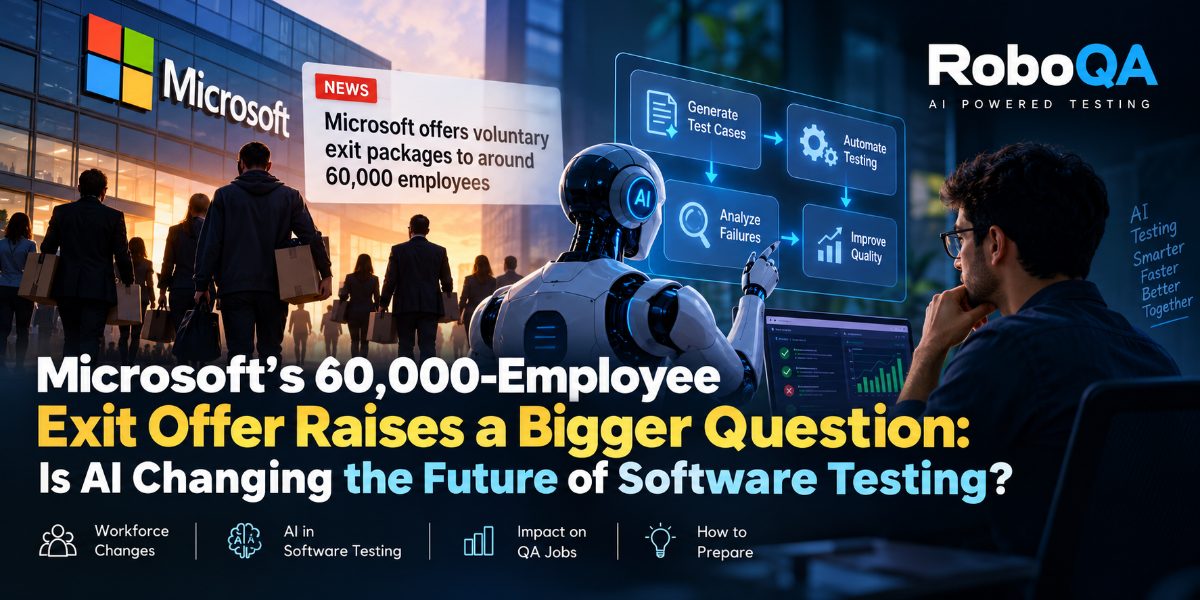
Microsoft’s 60,000-Employee Exit Offer Raises a Bigger Question: Is AI Changing the Future of Software Testing?
Microsoft is investing heavily in artificial intelligence while offering voluntary exit packages to tens of thousands of eligible employees. What does this mean for software testers, automation engineers, and the future of QA careers?
On October 26, 2026, Microsoft introduced a voluntary exit offer that could affect around 60,000 eligible employees. The announcement has renewed an important discussion across the technology industry: as companies invest more heavily in artificial intelligence, how will their workforces, job roles, and expectations of productivity change?
The headline is striking. A company building some of the world's most widely used AI products is also giving a substantial portion of its workforce an opportunity to leave with financial support.
But the situation needs context.
The 60,000 figure refers to employees eligible for the offer, not 60,000 confirmed departures. Microsoft described the programme as a voluntary exit option for eligible employees in participating organizations. The company has not said that AI alone is responsible for the programme.
Nevertheless, the announcement raises questions that software testers, developers, business analysts, and other technology professionals should take seriously.
If AI can write code, generate test cases, analyze failures, and automate workflows, what happens to the people whose work includes those activities?
Will companies need fewer software testers? Will AI testing tools become more valuable? And what should QA professionals learn today to remain effective in an industry that is changing rapidly?
The answers require looking beyond the headlines and examining what AI can actually do, what businesses need, and where human expertise continues to matter.
What Happened at Microsoft?
According to reporting by [Reuters](https://www.reuters.com/technology/microsoft-is-offering-buyouts-around-60000-employees-business-insider-reports-2026-10-26/), Microsoft announced a voluntary buyout programme covering approximately 60,000 eligible employees, representing more than a quarter of its global workforce of approximately 223,000 people.
The programme covers eligible employees in selected organizations in the United States, Canada, the United Kingdom, and India. Employees who qualify can review the offer and decide whether to accept it.
The announcement follows other workforce changes at Microsoft, including an earlier voluntary retirement programme and job reductions announced during 2026.
Microsoft is also making substantial investments in AI infrastructure, including the computing capacity required for cloud services and AI products.
These developments have brought workforce planning, AI investment, and operating costs into the same conversation.
However, three distinctions are essential.
First, eligibility is not the same as departure. The number of employees who ultimately accept a voluntary offer may be considerably smaller than the number eligible.
Second, voluntary exits are not identical to compulsory layoffs. Employees are being offered an option to leave under specified terms rather than all eligible employees being dismissed.
Third, correlation is not proof of causation. Microsoft is investing in AI while changing its workforce, but the company has not attributed this entire exit programme to AI replacing employees.
Why, then, is this relevant to software testing?
Because the announcement illustrates a broader challenge facing the technology industry: companies are reconsidering how they allocate people, capital, and computing resources while AI changes the way software is built and maintained.
For QA professionals, understanding that shift is more useful than assuming every workforce reduction is directly caused by AI.
The Bigger Picture: AI Is Changing the Economics of Software Development
Software companies have always looked for ways to improve productivity.
Traditional automation reduced repetitive work. Cloud computing reduced the need for organizations to manage all their infrastructure themselves. Continuous integration and continuous delivery made it possible to build, test, and release software more frequently.
AI introduces another layer of automation.
A developer can ask an AI coding assistant to generate a function. A tester can use an AI tool to draft test scenarios. An engineering team can analyze thousands of lines of logs with automated assistance. A business can use AI to summarize documents or process information that previously required substantial manual effort.
Each capability can reduce the time required for certain activities.
When a company can perform a task more efficiently, it has several choices. It can produce more output with the same workforce, redirect employees to more complex work, reduce costs, change hiring plans, or restructure particular teams.
Different companies will make different choices depending on their finances, competition, products, organizational structure, and expectations for growth.
This is where AI becomes an economic issue rather than merely a technical one.
The technology creates new capabilities, but management decides how those capabilities affect staffing, investment, and business strategy.
The same distinction applies to software testing.
AI might help a QA engineer generate hundreds of candidate test cases in minutes. Whether the company uses that productivity to improve coverage, accelerate releases, reduce overtime, or lower staffing costs is a business decision.
AI capabilities influence the available choices. They do not determine a single inevitable outcome.
Why Software Testing Is Particularly Exposed to AI Automation
Software testing contains many activities that are structured, repeatable, and based on identifiable rules.
These characteristics make certain testing tasks suitable for automation.
Consider a typical regression testing workflow. A QA engineer must identify relevant scenarios, prepare test data, execute tests, collect results, investigate failures, and communicate the findings.
Some of these activities require considerable judgment. Others are repetitive.
AI can assist with several parts of this process.
1. AI can generate test cases
A tester can provide a user story or acceptance criteria and ask an AI system to propose test scenarios.
For a login page, it might generate cases covering valid credentials, incorrect passwords, empty fields, account lockouts, session expiration, and password reset flows.
This can accelerate test design and reveal scenarios a tester might initially overlook.
However, generated scenarios still require validation. An AI model may misunderstand a requirement, duplicate existing tests, or miss an important business rule.
2. AI can help create automation scripts
AI coding assistants can draft automation scripts, explain existing code, suggest assertions, and help troubleshoot common programming errors.
This can lower the initial effort required to automate a workflow.
But generating a script is not the same as producing reliable automation. The script still needs to run in the intended environment, use appropriate selectors, validate meaningful outcomes, and handle failures correctly.
3. AI can assist with failure analysis
A failed test can generate screenshots, browser traces, console messages, network errors, and logs.
An AI-assisted failure analyzer can summarize this evidence, group similar failures, and suggest possible explanations.
For example, it may identify several tests failing after an authentication service starts returning errors. Instead of investigating each failure independently, the engineer can begin with a shared hypothesis.
The diagnosis must still be verified. A plausible explanation is not necessarily the root cause.
4. AI can improve regression test prioritization
Large applications may have thousands of regression tests. Running every test after every small change can be expensive.
AI-assisted test impact analysis can help identify tests associated with changed components, dependencies, previous failures, and higher-risk workflows.
This can help teams run relevant tests earlier and use testing time more effectively.
However, skipping tests based on an imperfect prediction can introduce risk. Critical releases may still require broad regression coverage.
5. AI can automate reporting and documentation
AI can summarize test execution, draft release reports, explain technical errors, and produce documentation from structured information.
These tasks can consume substantial time when performed manually.
Automation can reduce that overhead, although teams still need to verify summaries and ensure that failures and limitations are not omitted.
Taken together, these capabilities can change the amount of manual effort required for routine testing.
That is why QA professionals should pay attention to AI. Not because every testing job will disappear, but because the work expected from a testing team may change.
Will AI Replace Software Testers?
The most honest answer is that AI will automate some testing tasks, change many roles, and potentially eliminate certain positions. At the same time, it can enable new testing capabilities and create demand for different skills.
The outcome will depend on the organization, the maturity of its automation, the complexity of its products, and how management chooses to use the technology.
It helps to separate three categories of work.
Work that is increasingly automatable
Some activities are relatively straightforward to automate:
- Drafting routine test cases from clear requirements.
- Generating basic automation code.
- Executing repetitive regression tests.
- Producing standard test reports.
- Classifying recurring failures.
- Preparing common test data.
- Suggesting fixes for simple automation maintenance problems.
As tools improve, organizations may need fewer manual hours for these activities.
That could reduce the number of people required for some narrowly defined roles, especially where the work consists largely of repetitive execution and reporting.
This is a real risk, not something QA professionals should dismiss.
Work that still requires substantial engineering judgment
Other responsibilities are more difficult to reduce to a simple automated workflow:
- Understanding ambiguous business requirements.
- Identifying the most consequential product risks.
- Designing an effective testing strategy.
- Investigating unfamiliar failures.
- Evaluating complex user journeys.
- Assessing whether evidence is sufficient for a release.
- Testing interactions between systems.
- Making sure automation checks the right behavior.
- Communicating quality risks to stakeholders.
AI can assist with these activities, but assistance does not eliminate the need to evaluate its recommendations.
A system can generate thousands of tests and still miss the one business-critical scenario that matters most.
A test suite can report a high pass rate while failing to check whether a product behaves correctly for real users.
The value of a tester is therefore not determined only by how many tests they execute. It also depends on whether they understand what should be tested, why it matters, and how to interpret the results.
Work that may emerge as AI adoption grows
AI systems themselves need testing and monitoring.
Organizations deploying chatbots, AI agents, recommendation engines, and generative AI features need to assess accuracy, consistency, security, privacy, and reliability.
This creates opportunities for professionals who understand both software quality and AI behavior.
Other emerging responsibilities include evaluating AI-generated tests, monitoring autonomous testing agents, validating model updates, measuring flaky behavior, and building evidence-based evaluation systems.
These opportunities will not automatically compensate for every job affected by automation. Nor is every new role guaranteed to become a large employment category.
But they show why the future of QA is more complex than a simple prediction that AI will replace all testers.
The Real Risk: Becoming Dependent on Repetitive Work
The Microsoft announcement should not be interpreted as proof that AI is directly replacing software testers.
It does, however, provide a reason to think carefully about professional development.
A QA engineer whose work consists almost entirely of manually repeating the same test steps may face different risks from an engineer who designs automation frameworks, investigates complex failures, understands business processes, and evaluates new testing technologies.
The difference is not that one person is valuable and another is not. It is that some tasks are easier to automate than others.
As organizations adopt better tools, they may reconsider how much time should be spent on repetitive execution.
A professional who can use AI to reduce that effort while improving testing quality has more ways to contribute.
For example, rather than spending an entire afternoon writing routine test cases, a tester might use AI to produce an initial draft, validate it, and spend the saved time investigating a complicated checkout failure.
Rather than manually reviewing dozens of similar errors, the tester might use an AI-assisted analyzer to identify patterns and focus on the underlying issue.
Rather than simply reporting that a release has 20 failed tests, the tester might explain which failures affect critical user journeys, which appear to share a cause, and what additional evidence is needed before release.
These are examples of how the role can evolve from executing checks toward engineering, analysis, and risk management.
The important point is not to abandon fundamentals. It is to combine them with the tools that make the work more effective.
How AI Testing Can Help QA Professionals Rather Than Just Reduce Costs
There is another side to the discussion.
AI testing can help people handle the growing complexity of software without requiring every additional task to be performed manually.
Applications are increasingly interconnected. Teams release changes more frequently, use more third-party services, and deploy software across browsers, devices, and environments.
Testing every meaningful interaction manually is difficult to scale.
AI-assisted testing can help teams generate scenarios faster, analyze execution evidence, prioritize investigations, and maintain larger automation suites.
For an individual tester, this can mean less time spent on repetitive administration and more time spent understanding the product.
For a business, it can mean better testing coverage, faster feedback, and more informed release decisions.
For users, it can mean fewer defects reaching production—provided the testing process is properly designed and the AI's output is verified.
These benefits are not guaranteed. An unreliable AI testing system can generate false positives, overlook defects, and create additional maintenance work.
The goal should therefore be to measure improvements in software quality and engineering productivity, not simply the number of tasks handed to AI.
What QA Engineers Should Learn Now
The best response to this transition is to develop a combination of traditional testing expertise and modern AI-assisted engineering skills.
1. Learn automation properly
Become comfortable with browser automation frameworks such as Playwright or Selenium.
Understand selectors, assertions, waits, test isolation, fixtures, reporting, and debugging.
AI can generate code, but you need enough technical knowledge to determine whether that code is correct and maintainable.
2. Improve programming and debugging skills
Learn the programming language used by your automation framework. Understand HTTP requests, APIs, browser behavior, logs, and application architecture.
These skills help you investigate failures that cannot be resolved simply by generating another script.
3. Learn AI-assisted test generation
Practice generating tests from user stories, requirements, and acceptance criteria.
Compare AI-generated scenarios with your own test design. Identify missing cases, incorrect assumptions, and redundant tests.
The objective is to become effective at using and evaluating AI, not merely at writing prompts.
4. Understand AI failure analysis
Experiment with tools that analyze screenshots, traces, logs, and failed assertions.
Check whether their diagnoses match the evidence. Learn to distinguish an application defect from an environment issue, a test script problem, or an intermittent failure.
5. Learn to test AI applications
Study how to evaluate generative AI systems, including hallucinations, prompt injection, inconsistent outputs, privacy risks, and regression after model or prompt changes.
This adds a new dimension to traditional software quality engineering.
6. Develop business and risk awareness
Understand which features matter most to customers and which failures could affect revenue, security, compliance, or trust.
A good tester does not treat every failure as equally important. They help teams understand the potential consequences and prioritize investigation accordingly.
7. Build projects that demonstrate results
Create a practical project that uses AI to generate test scenarios, execute browser automation, collect evidence, and summarize failures.
Measure the results against a baseline.
How much time did it save? Were important scenarios missed? How many AI diagnoses were correct? Did maintenance effort improve?
Demonstrating measurable outcomes is more useful than simply claiming to know AI testing.
What Businesses Should Do Differently
The responsibility does not rest entirely on employees to adapt. Organizations also need to make sensible decisions about AI adoption and workforce development.
First, companies should identify where AI genuinely improves a workflow rather than implementing it simply because it is popular.
Second, they should evaluate quality and reliability, not just speed. A system that executes tests quickly but misses serious defects is not a successful testing solution.
Third, organizations should invest in training. Employees who understand existing systems often have valuable domain knowledge that can help implement and validate new AI workflows.
Fourth, they should establish clear review and accountability processes. AI-generated tests and diagnoses should be evaluated according to their risk and impact.
Finally, leadership should recognize that workforce changes have consequences for people, teams, and organizational knowledge. Reducing headcount may lower costs, but losing experienced employees can also affect product understanding, operational continuity, and engineering quality.
AI adoption is not simply a question of what technology can automate. It is a question of how organizations choose to redesign work.
Where AI Testing Platforms Fit Into This Future
This transition also creates an opportunity for software testing platforms such as RoboQA.
The objective should not be to promise that AI can replace an entire QA department. It should be to help testing professionals perform useful work more efficiently and make better-informed decisions.
An effective AI testing platform can support a connected workflow:
Generate → Execute → Analyze → Validate → Improve
It can help users create candidate test cases, run browser automation, collect execution evidence, analyze failures, and identify areas that deserve further investigation.
The most important principle is that AI-generated recommendations should remain connected to verifiable results.
If an AI tool says a test failed because of an authentication problem, the user should be able to inspect the relevant error, screenshot, trace, or response.
If a system proposes a new locator, the tool should verify that the locator identifies the intended element.
If an AI model generates test cases, users should be able to review the scenarios before relying on them.
This approach makes AI an engineering assistant rather than an unquestioned authority.
It also recognizes that testing expertise remains important. The quality of the result depends not only on the model, but on the test strategy, execution framework, validation rules, and evidence collected.
For QA professionals, tools built this way can reduce repetitive work while preserving the ability to investigate and understand the application.
For businesses, they can help scale testing without confusing automation volume with actual software quality.
The Bigger Lesson From Microsoft's Announcement
Microsoft's voluntary exit programme is a workforce announcement, not proof that AI has eliminated tens of thousands of jobs.
It should not be used to claim that software testing is disappearing, nor should it be dismissed as irrelevant to the future of QA.
The broader context is that technology companies are making major investments in AI while reviewing costs, organizational structures, and workforce needs.
AI is changing the economics of many tasks. Software testing is among the areas where these changes are visible because so much of the work involves repeatable processes, structured information, and measurable outcomes.
But testing is also about uncertainty, risk, business rules, and real-world user behavior. These are the areas where strong engineering judgment remains essential.
For individuals, the sensible response is to learn how to work effectively with AI while strengthening automation, debugging, analytical thinking, and domain knowledge.
For organizations, the challenge is to adopt AI responsibly, measure its real impact, and avoid sacrificing reliability for short-term efficiency.
For software testing platforms, the opportunity is to make intelligent testing more accessible, transparent, and dependable.
Final Thoughts: The Future Belongs to Better Testing, Not Just More Automation
Microsoft's announcement has brought an uncomfortable question back into focus: what happens to technology careers as AI becomes more capable?
There is no single answer for every profession or organization. Some tasks will be automated, some roles will change, and some positions may disappear. New opportunities will also emerge, although they will not necessarily offset every loss.
Software testers should take the change seriously without assuming that their profession has no future.
The strongest response is to become more capable: learn automation, understand AI tools, investigate complex failures, evaluate evidence, and connect testing decisions to business outcomes.
AI can generate a test case, but someone still needs to determine whether it tests the right thing. AI can summarize a failure, but the explanation needs to be verified. AI can execute a workflow, but the result must still mean something in the context of the product.
That is where quality engineering becomes more than test execution.
The real question is not whether AI can perform testing tasks. It is whether we can use AI to build better software, make better decisions, and create more reliable products without losing sight of the people affected by technological change.
The future of QA will be shaped by both the capabilities of AI and the decisions that people make about how to use it.
For software testers, the time to prepare is now.
---
This article is part of RoboQA's ongoing exploration of AI-powered software testing, quality engineering, automation, and the changing future of technology careers.
Sources and further reading
- [Reuters — Microsoft offers buyouts to around 60,000 employees](https://www.reuters.com/technology/microsoft-is-offering-buyouts-around-60000-employees-business-insider-reports-2026-10-26/)
- [The Indian Express — Microsoft offers voluntary exit packages to eligible employees, including in India](https://indianexpress.com/article/technology/microsoft-offers-voluntary-exit-packages-to-60000-eligible-employees-including-in-india-10938060/)
- [TechCrunch — Microsoft offers buyouts to around 60,000 employees](https://techcrunch.com/2026/10/26/microsoft-offers-buyouts-to-around-60000-employees-reports-say/)