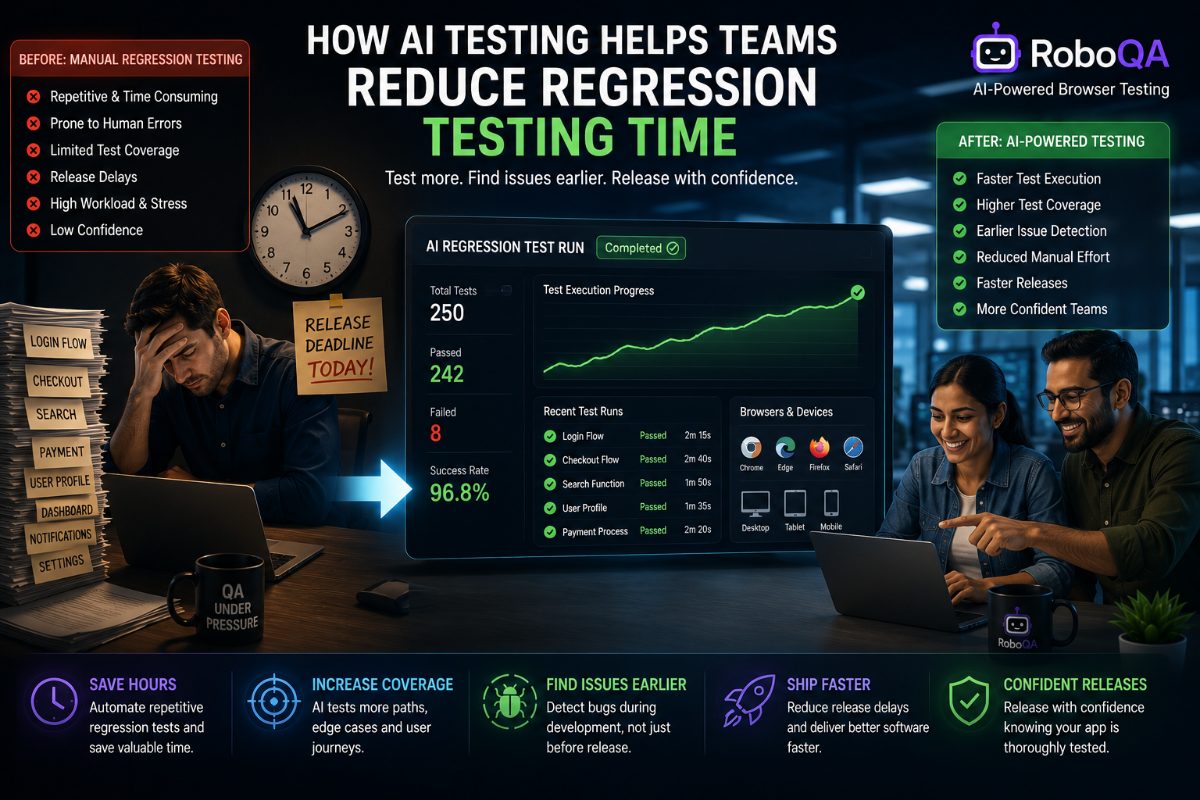
AI Testing Tools: The Future Of Automated Browser Testing
Software testing has always followed the same pattern.
A human understands what needs to be tested.
A tester creates steps.
Automation engineers convert those steps into scripts.
The scripts run.
The results are analysed.
For years, this worked.
But modern software has become much faster and more complex.
Applications change every week.
User interfaces are constantly redesigned.
New devices and browsers appear.
And traditional automation struggles to keep pace.
This is where AI testing tools are changing the way teams approach quality.
---
The Problem With Traditional Browser Automation
Traditional automation tools are powerful.
Tools like Selenium and Playwright helped teams automate thousands of workflows.
But they require maintenance.
Every automated test depends on technical details:
- Element selectors
- XPath paths
- Page structures
- Test data
- Framework code
When the application changes, automation often breaks.
A small UI update can create hours of debugging.
The team spends time fixing tests instead of testing the product.
---
AI Testing Uses A Different Approach
AI testing tools focus less on technical instructions and more on user behaviour.
Instead of writing:
"Find this button using this selector and click it."
You can describe:
"Verify that users can complete the checkout process successfully."
The AI agent understands the objective.
It navigates the application.
It observes the result.
It reports what happened.
---
Why Natural Language Testing Matters
Software teams already communicate in natural language.
Product managers describe requirements.
Developers discuss features.
QA engineers write test scenarios.
AI testing brings automation closer to this workflow.
A QA engineer can describe:
"Test user registration. Check validation messages. Confirm successful account creation."
The system can execute the workflow without requiring a custom automation framework.
---
AI Testing Does Not Mean No-Code Testing Only
The biggest advantage is not simply avoiding code.
The real advantage is reducing maintenance.
Traditional automation requires maintaining the instructions.
AI testing focuses on maintaining the intention.
The goal remains:
"Verify this experience works."
Not:
"Verify this exact selector exists."
---
Where AI Browser Testing Helps Most
AI-powered browser testing is especially useful for:
Regression Testing
Repeatedly checking existing functionality after changes.
User Journey Testing
Testing complete flows instead of isolated buttons.
UI Validation
Checking layouts, forms, and important user interactions.
Release Confidence
Finding issues before customers discover them.
---
How RoboQA Helps
RoboQA allows teams to test websites using simple instructions.
Provide:
- Website URL
- Feature to test
- Expected behaviour
RoboQA runs the browser workflow and generates a testing report.
No large automation setup.
No fragile scripts for every small change.
---
The Future Of Testing
AI will not replace quality engineers.
It will remove repetitive execution.
The best QA teams will combine:
Human judgement + AI execution.
That means faster feedback, better coverage, and more time spent on meaningful quality work.
---
Final Thoughts
The future of browser testing is moving from:
"Write every testing step."
to:
"Describe what quality should look like."
AI testing tools are making automated testing faster, smarter, and easier to maintain.