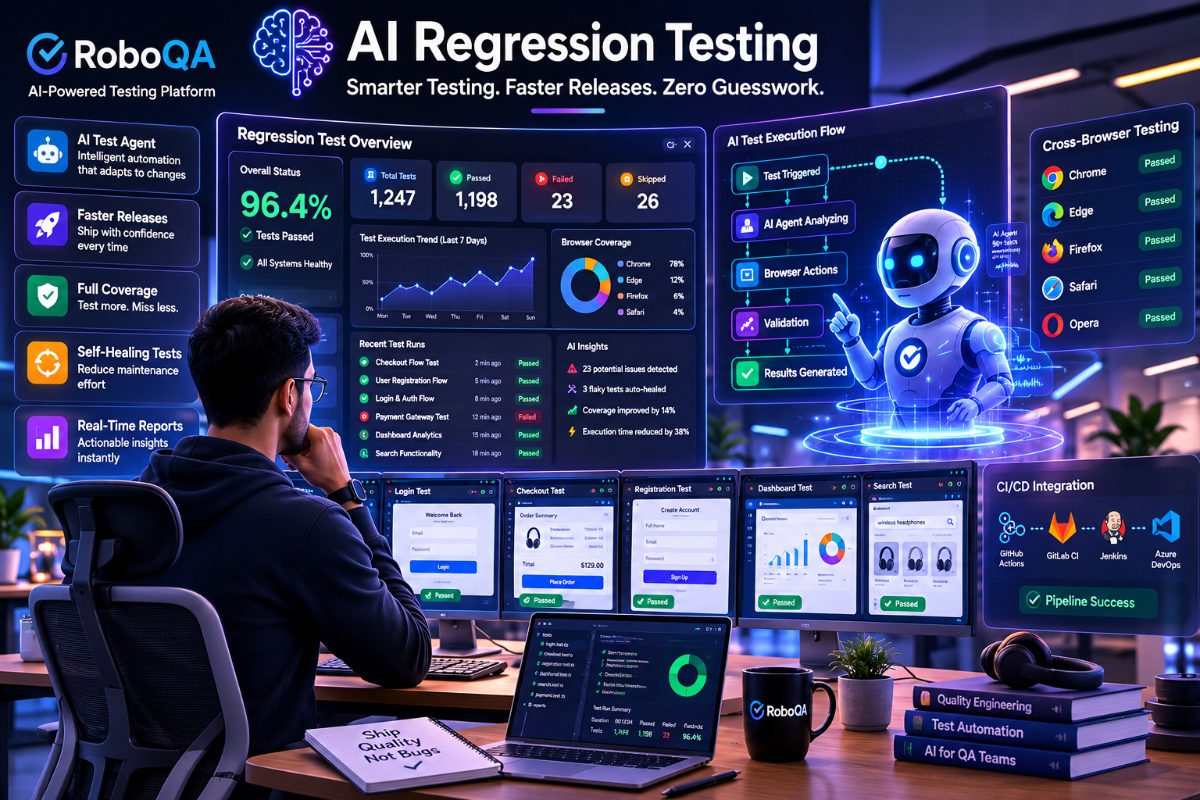
AI Regression Testing: How Engineering Teams Can Release Faster With More Confidence
Software teams are releasing updates faster than ever before.
New features are deployed weekly.
Sometimes daily.
For teams practicing Continuous Integration and Continuous Delivery (CI/CD), software is constantly evolving.
While faster releases improve innovation, they also introduce a major challenge.
How do you ensure existing features continue working after every change?
This is exactly why regression testing exists.
Regression testing verifies that newly added code hasn't unintentionally broken existing functionality.
Without it, every release carries hidden risks.
But traditional regression testing is becoming increasingly difficult to maintain.
As applications grow larger, testing every important workflow manually becomes unrealistic.
This is where AI regression testing is beginning to change the way modern engineering teams approach software quality.
---
What Is Regression Testing?
Regression testing is the process of re-running existing tests after software changes.
The goal is simple:
Ensure previously working functionality continues to work correctly.
For example, imagine an e-commerce website.
The development team updates the product recommendation engine.
Although the new feature works perfectly, it unexpectedly affects:
- Shopping cart behavior
- Checkout process
- Product search
- User login
- Order confirmation
Without regression testing, these unrelated issues may only be discovered after customers begin using the application.
Regression testing acts as a safety net before every release.
---
Why Regression Testing Becomes Difficult
Regression testing starts small.
A few test cases.
A handful of user journeys.
Simple validation.
As the product grows, so does the testing workload.
A mature web application may require validation of:
- Authentication
- User registration
- Password reset
- Shopping cart
- Checkout
- Search
- User dashboard
- Notifications
- Reports
- Mobile responsiveness
Now imagine repeating these workflows after every release.
The effort grows exponentially.
Manual execution quickly becomes impossible.
---
Traditional Automation Helped—But Introduced New Challenges
Automation frameworks such as Selenium and Playwright transformed regression testing.
Instead of manually executing repetitive workflows, scripts could perform those tasks automatically.
This dramatically increased testing speed.
However, automation introduced a different challenge.
Maintenance.
Every UI redesign.
Every renamed button.
Every modified page structure.
Every updated workflow.
Suddenly dozens—or even hundreds—of automated tests require updates.
Instead of validating software, engineers begin maintaining automation.
For many organizations, maintenance becomes one of the largest hidden costs of regression testing.
---
Modern Software Requires Smarter Regression Testing
Today's applications evolve constantly.
Design systems change.
Components are reused.
User experiences improve.
Features are released continuously.
Regression testing must evolve alongside the software.
Engineering teams need testing systems that adapt more naturally to change.
This is where artificial intelligence is creating new possibilities.
---
How AI Regression Testing Works
Rather than relying exclusively on predefined scripts, AI-powered testing focuses on user goals.
Instead of writing every browser interaction step-by-step, testers describe the outcome they want to verify.
Examples include:
"Verify a customer can successfully complete checkout."
"Ensure users can register using a valid email address."
"Validate product search returns relevant results."
The AI agent interprets the testing objective.
It interacts with the application.
Executes the workflow.
Collects evidence.
Reports failures.
This changes regression testing from a script-centric activity into a goal-oriented process.
---
Benefits of AI Regression Testing
Faster Test Creation
Teams spend less time writing repetitive automation code.
New workflows can be described much more quickly.
---
Reduced Maintenance
Modern AI systems focus more on application behavior than fixed selectors.
Minor UI changes are less likely to require complete test rewrites.
---
Better Test Coverage
Engineering teams can validate more user journeys before every release.
This increases confidence without dramatically increasing effort.
---
Earlier Bug Detection
Continuous AI testing identifies problems before production deployments.
Finding defects earlier reduces the cost of fixing them.
---
Improved QA Productivity
QA engineers spend less time repeating regression cycles.
Instead, they focus on:
- Exploratory testing
- Risk analysis
- Product quality
- Edge cases
- Customer experience
AI handles repetitive execution.
Humans provide judgment.
---
AI Regression Testing in Continuous Delivery
Modern DevOps teams release software frequently.
Traditional regression cycles often become bottlenecks.
AI-powered testing fits naturally into CI/CD pipelines.
Every build can trigger automated browser validation.
Critical workflows are verified immediately.
Developers receive feedback earlier.
Releases become more predictable.
This supports faster software delivery without sacrificing quality.
---
Where AI Regression Testing Delivers the Most Value
AI regression testing is especially valuable for:
- SaaS platforms
- E-commerce applications
- Customer portals
- Banking systems
- Healthcare applications
- Enterprise dashboards
- Internal business tools
Any application with frequent updates can benefit from faster regression validation.
---
How RoboQA Simplifies Regression Testing
RoboQA helps engineering teams automate browser-based regression testing using AI.
Instead of creating large automation frameworks, teams simply describe the workflow they want to validate.
Examples include:
- Verify login.
- Test checkout.
- Validate registration.
- Check search functionality.
- Confirm dashboard loads correctly.
The AI agent performs browser interactions, identifies issues, captures evidence, and generates detailed reports.
This allows QA teams to focus on improving software quality rather than maintaining scripts.
---
The Future of Regression Testing
Regression testing will always remain essential.
Software will continue changing.
New features will continue introducing risk.
The difference is how testing will be performed.
Instead of maintaining thousands of fragile scripts, engineering teams are beginning to adopt systems that understand testing objectives.
AI isn't replacing quality engineers.
It's helping them spend more time improving software—and less time repeating it.
---
Final Thoughts
Regression testing is one of the most important activities in software delivery.
But traditional approaches struggle to keep pace with modern development cycles.
AI-powered regression testing offers a smarter way forward.
By combining human expertise with intelligent automation, teams can release faster, reduce risk, and build software with greater confidence.
FAQ
Frequently Asked Questions
What is AI regression testing?
AI regression testing uses artificial intelligence to automate the validation of existing application functionality after code changes. Instead of relying only on fixed automation scripts, AI can execute user workflows, analyze results, and detect unexpected issues with less manual effort.
---
How is AI regression testing different from traditional automation?
Traditional automation depends on predefined scripts that often require maintenance whenever the application's UI changes.
AI regression testing focuses on testing objectives rather than fixed instructions, making it more adaptable to modern applications.
---
Can AI replace Selenium or Playwright?
Not completely.
Selenium and Playwright remain powerful automation frameworks.
AI testing complements them by reducing repetitive work, simplifying browser testing, and helping teams automate user journeys faster.
Many engineering teams will use all three together.
---
Which applications benefit most from AI regression testing?
AI regression testing is especially useful for:
- SaaS platforms
- E-commerce websites
- Banking applications
- Healthcare software
- Customer portals
- Enterprise dashboards
- Internal business applications
Any application with frequent releases can benefit from AI-powered regression testing.
---
How does RoboQA help with regression testing?
RoboQA allows QA teams to describe testing scenarios in natural language.
The AI agent performs browser interactions, validates workflows, captures evidence, and generates detailed reports, allowing engineers to focus on software quality instead of maintaining automation scripts.
RoboQA CTA
Ready to Modernize Your Regression Testing?
Traditional regression testing becomes harder as applications grow.
RoboQA uses AI-powered browser automation to help engineering teams validate user journeys, detect issues earlier, and release software with greater confidence.
Describe what you want to test, and let AI handle the repetitive work.
Explore RoboQA and discover a smarter approach to software testing.