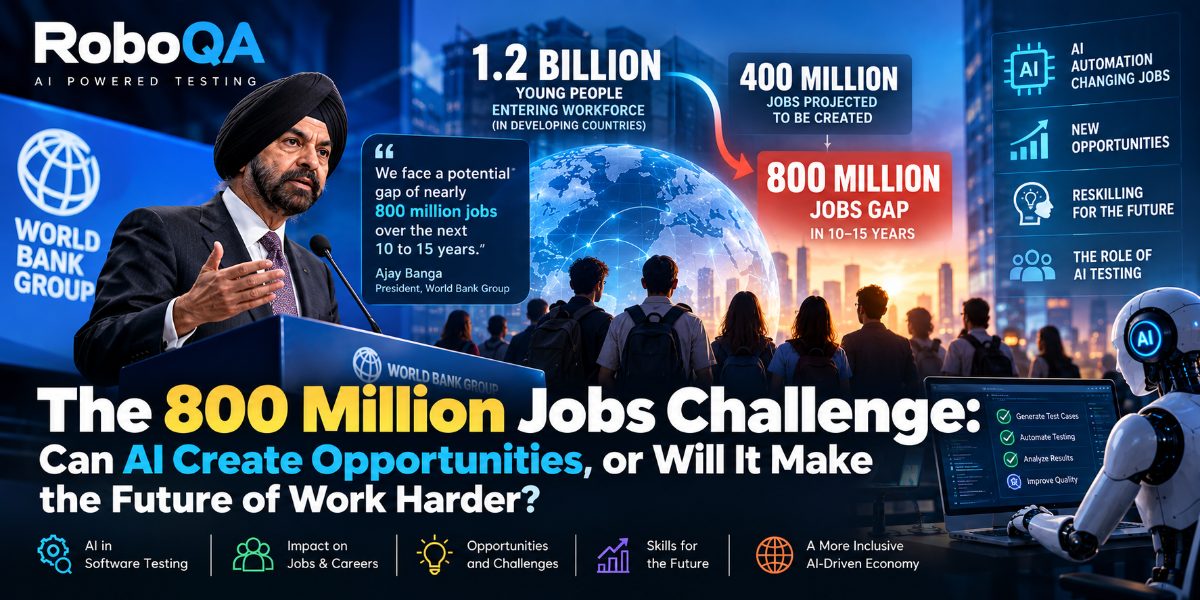
The World Bank's Ajay Banga has highlighted a projected gap of nearly 800 million jobs over the next 10 to 15 years. As artificial intelligence transforms software development, testing, and business operations, one question becomes increasingly important: can AI help create the opportunities the next generation needs?
The global conversation about artificial intelligence often focuses on what machines can do.
AI can write code, generate images, analyze documents, automate workflows, answer questions, and help businesses operate more efficiently. New models and tools are being released rapidly, and organizations are exploring ways to accomplish more with fewer manual steps.
But there is another side to this technological transformation.
What happens to the people who need jobs?
What happens to graduates looking for their first opportunity, workers whose daily tasks can be automated, and developing economies that need to create millions of productive jobs every year?
These questions have become particularly important following a warning from World Bank Group President Ajay Banga.
At the World Bank Group's 2026 Annual Meetings, Banga highlighted a projected employment challenge: over the next 10 to 15 years, approximately 1.2 billion young people in developing countries will reach working age, while current projections suggest that only around 400 million jobs will be created. That implies a potential gap of nearly 800 million jobs.
This is a projection, not a count of existing unemployed people or jobs already eliminated by AI. Nevertheless, it illustrates the enormous scale of the employment challenge facing developing economies.
Source: [World Bank Group — Remarks by President Ajay Banga at the 2026 Annual Meetings Plenary](https://www.worldbank.org/en/news/speech/2026/10/16/remarks-by-world-bank-group-president-ajay-banga-at-the-2026-annual-meetings-plena).
Now consider this challenge alongside the rapid adoption of artificial intelligence.
AI can increase productivity, help small businesses grow, and enable people to perform tasks that previously required specialized knowledge. At the same time, it can reduce the need for certain tasks and change the skills employers expect from workers.
The outcome will depend on how businesses, governments, educational institutions, and individuals respond.
For the software industry, and particularly software testing, this is not a distant question. AI is already changing how testing work can be performed.
Understanding that transformation can help us think more clearly about the future of work.
1. Understanding the 800 Million Jobs Gap
The numbers highlighted by Ajay Banga describe a mismatch between the number of young people expected to enter working age and the number of jobs projected to be created.
The figures can be summarized as follows:
| Measure | Projection |
|---|---:|
| Young people reaching working age in developing countries | 1.2 billion |
| Jobs projected to be created | 400 million |
| Potential gap | 800 million |
| Time horizon | 10–15 years |
Source: [World Bank Group](https://www.worldbank.org/en/news/speech/2026/10/16/remarks-by-world-bank-group-president-ajay-banga-at-the-2026-annual-meetings-plena).
The distinction is important. The 800 million figure does not mean that 800 million people have already lost their jobs, nor does it mean AI will eliminate 800 million positions.
It represents a potential shortage of employment opportunities relative to the number of young people expected to reach working age.
The challenge is particularly significant for developing economies, where large young populations can create enormous economic potential if people have access to productive work.
A growing workforce can support economic growth, entrepreneurship, innovation, and consumer demand. But that potential is harder to realize when people cannot find meaningful ways to earn a living.
A young person entering the workforce needs more than access to technology. They need opportunities to apply their knowledge, develop skills, support themselves, and build a career.
This is why the jobs gap is fundamentally an economic development challenge.
It requires investment, productive businesses, infrastructure, education, and opportunities for entrepreneurship. AI is one part of that picture, but it cannot solve the problem on its own.
2. AI Is Changing the Relationship Between Productivity and Employment
For much of modern economic history, technological progress has helped people produce more goods and services with less effort.
Machines improved manufacturing productivity. Computers accelerated calculations and record-keeping. The internet made it easier to distribute information and reach customers. Cloud computing reduced the cost and complexity of deploying software.
Artificial intelligence introduces another layer of change.
A small business owner can use AI to draft marketing material, analyze customer feedback, summarize financial information, or build an initial version of a website. A developer can use an AI assistant to generate code. A software tester can use AI to propose test cases and investigate failures.
These capabilities can reduce the time required to complete certain tasks.
But productivity and employment are not the same thing.
When a business becomes more productive, it may use the improvement to expand its operations, reduce prices, increase profits, improve products, or reduce its workforce.
If lower costs enable a business to serve more customers, it may hire additional employees. If the business can maintain the same output with fewer workers and has little opportunity to expand, it may reduce hiring or staffing.
Both outcomes are possible.
The effect depends on demand, competition, investment, the type of work being automated, and how organizations choose to respond.
This is the central economic question surrounding AI: can the productivity it creates translate into enough new economic activity and employment opportunities?
The answer cannot be determined simply by measuring how capable an AI model becomes.
3. Why AI Can Create Jobs and Reduce Demand for Other Jobs at the Same Time
It is tempting to view AI as either a job creator or a job destroyer.
In reality, it can do both.
Consider a business that introduces AI-assisted customer support. It may need fewer people to handle repetitive questions. However, if the technology reduces operating costs and improves customer service, the business might expand into new markets, create new products, or hire people for other responsibilities.
The original jobs may change even when the company grows.
The same pattern can appear in software development and testing.
AI can generate automation scripts, but businesses still need to define what those scripts should verify. AI can summarize test failures, but teams need to investigate serious defects. AI can generate code, but that code must be reviewed, integrated, secured, and maintained.
At the same time, a company may decide that it needs fewer people to perform certain repetitive activities.
This creates three important possibilities:
- Task automation: Some existing responsibilities require less manual effort.
- Job transformation: Workers take on different responsibilities, combining AI tools with their existing expertise.
- Job creation: New products, services, businesses, and technical capabilities generate demand for new kinds of work.
The balance between these outcomes will vary across industries and countries.
The World Bank's research on AI and employment emphasizes that developing countries face different opportunities and risks depending on their digital infrastructure, workforce composition, skills, and ability to adopt AI. In many developing economies, AI may initially complement workers rather than directly replace them, although knowledge-intensive services face different pressures.
Source: [World Bank — World Development Report 2026: The Promise of Artificial Intelligence](https://www.worldbank.org/en/publication/wdr2026).
The important lesson is that technological progress alone does not guarantee that its economic benefits will be distributed broadly.
That requires deliberate investment in people, businesses, infrastructure, and skills.
4. The First Job Problem: Why Young Professionals Need to Pay Attention
One of the most important aspects of the AI employment discussion is the potential impact on entry-level opportunities.
A person entering the workforce usually begins with tasks that are relatively structured and supervised.
A junior developer might write straightforward functions, fix small bugs, or create basic tests. A junior QA engineer might execute test cases, document defects, validate form fields, and maintain simple automation scripts.
These tasks are valuable because they help people learn how real systems work.
They provide opportunities to develop judgment, understand business processes, and gradually take responsibility for more complex work.
But many entry-level tasks are also suitable candidates for automation.
If AI tools can generate basic code, draft test cases, summarize reports, and answer routine questions, employers may need fewer hours of junior-level work to complete the same volume of tasks.
That does not automatically mean companies will stop hiring junior employees. They may expand their output, introduce new services, or expect entry-level workers to become productive in different ways.
However, it does raise an important question: if AI automates some of the tasks through which people traditionally learn, how will the next generation gain experience?
A junior employee cannot develop expert judgment without opportunities to practice, make mistakes, investigate problems, and receive feedback.
Companies adopting AI should consider how they will train new employees rather than simply expecting them to arrive fully prepared.
Educational institutions also need to evolve. Learning how to use AI is useful, but students must also understand the fundamentals behind the work they are asking AI to perform.
For aspiring software testers, this means learning testing principles, automation, debugging, and system behavior—not merely learning how to generate a test script with a prompt.
5. How AI Is Changing Software Testing
Software testing provides a practical example of how AI can automate individual tasks while creating new demands for technical expertise.
Traditional software testing involves understanding requirements, designing test cases, executing tests, investigating defects, and evaluating whether an application behaves as expected.
Automation has already reduced the need to perform many repetitive checks manually.
AI adds capabilities that can help with test creation, maintenance, analysis, and prioritization.
AI test case generation
AI tools can generate candidate test cases from requirements, user stories, acceptance criteria, and other contextual information.
For example, a tester working on an online payment system might ask AI to suggest scenarios involving successful payments, invalid card details, declined transactions, duplicate submissions, interrupted payments, and refunds.
The tester can review the proposed scenarios, remove irrelevant cases, add missing business rules, and decide which tests should be automated.
This can accelerate test design, but the generated cases still need validation.
AI-assisted test automation
AI coding assistants can draft automation scripts, explain existing code, suggest selectors, and help troubleshoot common errors.
This can make it easier to build an initial automation workflow.
However, generated scripts must still be executed and verified. A script that runs without errors does not necessarily test the correct behavior.
AI failure analysis
When a test fails, an AI-assisted tool can examine logs, screenshots, browser traces, and error messages to suggest possible causes.
Instead of manually reviewing every line of evidence, a tester may receive a summary of the likely failure area and the next steps to investigate.
The suggested explanation remains a hypothesis until verified.
AI-assisted regression testing
AI can help identify tests that may be affected by a code change, prioritize high-risk scenarios, and highlight gaps in regression coverage.
This can help teams focus their attention on the areas most likely to be affected.
However, automated prioritization should not become an excuse to ignore critical tests. Incorrect assumptions about dependencies can allow defects to escape.
AI testing for AI applications
As businesses introduce chatbots, AI agents, and generative AI features, those systems need testing too.
Testing may involve evaluating hallucinations, inconsistent responses, prompt injection, privacy risks, biased behavior, and regression after model or prompt changes.
These systems can behave differently for similar inputs, so testing requires suitable evaluation criteria rather than relying exclusively on exact-match assertions.
This creates a broader role for quality engineering: verifying both conventional software and the AI systems increasingly embedded within it.
6. Will AI Testing Eliminate QA Jobs?
AI testing will automate some activities, change existing roles, and create opportunities for new skills. It would be unrealistic to promise that no QA positions will be affected.
But it would also be inaccurate to conclude that AI will make software testers unnecessary.
The outcome depends partly on what an organization expects its testing team to accomplish.
If the role consists mainly of manually repeating a fixed set of test steps, much of that work may be automated.
If the role includes designing test strategies, understanding complex business requirements, investigating failures, assessing risks, and evaluating whether a release is ready, the responsibilities are broader.
AI can support these activities, but the quality of the final decision depends on the evidence, the testing strategy, and the ability to recognize incorrect or incomplete results.
Consider a simple example.
An AI system generates 500 test cases for a banking application. That may sound impressive.
But what if the tests fail to verify an important transaction limit? What if they overlook a security weakness? What if the application passes every generated test but still allows a critical business rule to be bypassed?
The number of generated tests is not the same as the quality of the testing process.
A skilled QA engineer needs to understand what matters, identify missing scenarios, validate results, and communicate the consequences of unresolved risks.
This is why learning AI tools should go hand in hand with learning software testing fundamentals.
The objective is to become capable of building and evaluating reliable testing systems—not simply to produce more automation.
7. AI Testing as an Opportunity for Developing Economies
The employment challenge highlighted by Ajay Banga is particularly relevant to developing economies because they need both job creation and productivity growth.
AI can help smaller businesses access capabilities that were previously expensive or difficult to obtain.
A startup may use AI to accelerate software development. A small retailer may analyze sales data without building a large analytics department. A farmer may use AI-assisted services to access information about crops, weather, and market conditions. A small company may use automated testing tools to improve the reliability of its website.
These are examples of how technology can help businesses operate more effectively.
But access to AI alone is not enough.
Businesses need electricity, connectivity, suitable devices, relevant data, skills, and affordable tools. They also need customers who are willing to pay for their products and services.
The World Bank has emphasized the importance of practical, affordable AI applications that address local needs, particularly in sectors such as agriculture, healthcare, education, logistics, and small-business finance.
Source: [World Bank — Small AI: More and Better Jobs](https://live.worldbank.org/en/event/2026/annual-meetings-small-ai-big-jobs).
This approach matters because the economic value of AI is not limited to building the largest models.
Many opportunities involve applying existing technology to real problems.
A small business may benefit more from an inexpensive tool that improves inventory management than from an advanced AI system it cannot afford to operate.
Similarly, a QA team may benefit more from a reliable tool that generates useful tests and explains failures than from an expensive system that promises complete autonomous testing without demonstrating dependable results.
The challenge is to make useful technology accessible and economically valuable.
8. Why AI Tools Should Solve Real Problems, Not Just Demonstrate AI
The expansion of AI has encouraged businesses to build tools around new model capabilities.
But a working demonstration does not necessarily make a sustainable product.
A useful tool must solve a problem that people actually have, fit into their existing workflows, and provide value that justifies its cost.
This is especially important for AI testing tools.
A QA engineer does not necessarily need another chatbot that can discuss software testing. They may need a tool that can turn requirements into reviewable test cases, execute browser workflows reliably, collect evidence, identify likely failure causes, and produce a clear report.
A small business analyst may not need a complex AI platform. They may need a straightforward tool that analyzes a CSV file, identifies missing values, calculates important metrics, and explains the results.
In both cases, the product should start with the user's problem.
AI can make the solution more useful, but it should not be added simply to make the product appear modern.
For developers and entrepreneurs, this creates an important opportunity: build focused tools that make valuable capabilities accessible to people and businesses that cannot afford large teams or expensive enterprise software.
When those tools help businesses save time, improve quality, or make better decisions, they can contribute to productivity growth.
Whether that productivity translates into additional employment depends on how businesses grow and use the resulting gains.
9. What Should Software Testers Learn in an AI-Driven Economy?
For QA professionals, the most practical response to AI is to develop a combination of engineering fundamentals and AI-assisted capabilities.
Strengthen automation skills
Learn frameworks such as Playwright or Selenium, along with programming, assertions, test data management, debugging, and continuous integration.
Understanding automation makes it easier to evaluate AI-generated scripts and maintain reliable test suites.
Learn to evaluate AI output
Practice generating test cases, analyzing failures, and creating automation scripts with AI assistance.
Then verify the results. Identify incorrect assumptions, missing cases, and unsupported diagnoses.
The ability to evaluate AI output is as important as the ability to generate it.
Improve analytical thinking
Learn how to investigate browser traces, network requests, logs, application state, and system dependencies.
These skills help you diagnose complex problems rather than relying on an AI-generated explanation.
Understand AI application testing
Explore hallucination testing, prompt injection, evaluation datasets, model regression, privacy, and consistency.
As organizations integrate AI into their products, testing professionals need methods for evaluating behavior that may vary between runs.
Develop business understanding
Understand how defects affect revenue, security, customer trust, and operations.
This helps you prioritize risks and communicate why a particular failure matters.
Build practical projects
Create a small workflow that generates test cases, runs browser automation, collects evidence, and summarizes failures.
Measure how much time it saves, whether the tests are relevant, how accurately failures are diagnosed, and what maintenance is required.
A practical portfolio can demonstrate that you know how to use AI responsibly rather than simply how to operate a tool.
The broader lesson is that professionals should learn to work with AI while retaining the knowledge needed to check its work.
10. What Businesses and Governments Need to Do
Individuals cannot solve the employment challenge alone.
Businesses, governments, and educational institutions also have responsibilities.
Businesses need to invest in productive growth. AI adoption should be connected to better products, improved services, and new opportunities, not just reductions in operating costs.
Educational institutions need to teach adaptable skills. Students should understand the fundamentals of their disciplines while learning how to use AI tools effectively.
Governments need to support the conditions for job creation. Infrastructure, reliable electricity, connectivity, access to finance, practical training, and an environment where businesses can grow all matter.
Employers need to rethink entry-level training. If AI automates routine work, companies should develop new ways for junior employees to gain experience, receive feedback, and progress into more complex responsibilities.
Technology companies need to focus on useful applications. Tools that help smaller businesses improve productivity can extend the benefits of AI beyond organizations with large budgets and specialized teams.
These measures cannot guarantee that every displaced worker will find an equivalent opportunity. Nor can they eliminate the uncertainty surrounding future employment.
But they can help improve the conditions under which AI contributes to economic development rather than widening existing gaps.
11. The Future of AI Testing: From Automating Tasks to Improving Quality
For RoboQA and the wider software testing industry, the opportunity is to help people and organizations use AI to make testing more effective.
A practical AI testing platform can support a workflow that moves through several stages:
Generate → Execute → Analyze → Validate → Improve
First, the platform helps create candidate test cases. It then executes them through a suitable automation engine, collects evidence, analyzes failures, and helps users identify what needs attention.
The AI should assist the process without replacing the mechanisms that verify the result.
For example, browser automation should actually execute the workflow. Assertions should check expected behavior. Accessibility and performance tools should perform their appropriate measurements. AI can help generate scenarios, interpret evidence, and suggest improvements.
This approach is important for two reasons.
First, it makes the tool more useful to QA engineers by reducing repetitive work and making failures easier to investigate.
Second, it creates a clearer basis for evaluating the product. Teams can measure execution reliability, defect detection, maintenance effort, and the accuracy of AI-generated diagnoses.
A product that demonstrates measurable value is more likely to be useful to businesses than one that simply promises that AI can automate everything.
The same principle applies to business analytics tools and other AI-assisted products.
Start with a real problem, build a dependable solution, measure the results, and expand based on what users actually need.
That is how AI capabilities can become useful economic infrastructure rather than just another technology demonstration.
Conclusion: The Challenge Is Not Just AI Taking Jobs. It Is Creating Enough Opportunity.
Ajay Banga's warning about the projected 800 million jobs gap highlights a major challenge facing developing economies over the next 10 to 15 years.
The numbers describe a potential mismatch between the number of young people reaching working age and the employment opportunities expected to be created. They do not establish that AI will eliminate 800 million jobs.
Nevertheless, the rise of AI makes the question of future employment more urgent.
AI can increase productivity, help businesses grow, make specialized capabilities more accessible, and enable people to perform new kinds of work. It can also automate existing tasks, change hiring requirements, and create difficulties for workers whose experience is concentrated in activities that are becoming easier to automate.
Both outcomes deserve attention.
For software testers, the practical response is to strengthen automation, debugging, analytical thinking, and AI evaluation skills. For businesses, the opportunity is to use AI to improve quality, develop products, and create value rather than focusing exclusively on reducing costs.
For developing economies, the larger task is to create the conditions that allow productive businesses to emerge and expand.
The future of work will not be determined by AI capabilities alone. It will also depend on investment, education, infrastructure, entrepreneurship, and the decisions organizations make about how technology is used.
The real challenge is not simply teaching people to use AI. It is building an economy in which AI helps more people become productive, earn a living, and participate in creating value.
AI can make work more efficient. The next challenge is ensuring that its benefits help create enough meaningful opportunities for the people who need them.
---
This article is part of RoboQA's ongoing exploration of AI-powered software testing, automation, the future of work, and the practical application of artificial intelligence.