Why Browser Testing Breaks — And How AI Makes It More Reliable
Modern software is built for browsers.
Whether you're developing a SaaS platform, an e-commerce website, a banking application, or an internal enterprise portal, one thing remains constant:
Your users experience your product through a browser.
If something breaks there, your customers notice immediately.
That's why browser testing has become one of the most important responsibilities for software teams.
Yet it's also becoming one of the hardest.
Applications evolve every week.
Browsers receive constant updates.
Responsive layouts change.
JavaScript frameworks evolve.
User expectations continue to rise.
Testing a modern web application isn't simply about checking if a page loads anymore.
It's about ensuring every interaction works flawlessly across multiple environments.
This growing complexity is exactly why many engineering teams are rethinking how browser testing should be performed.
---
Browser Testing Has Changed Dramatically
Ten years ago, browser testing was relatively straightforward.
A handful of browsers.
Desktop devices.
Limited JavaScript.
Simple page layouts.
Today's web applications are completely different.
A single application may include:
- Dynamic interfaces
- Single Page Applications (SPA)
- Micro-frontends
- APIs
- Third-party integrations
- Responsive components
- Progressive Web Apps
- Real-time updates
Every release introduces hundreds of possible interactions.
Every interaction becomes another opportunity for something to fail.
---
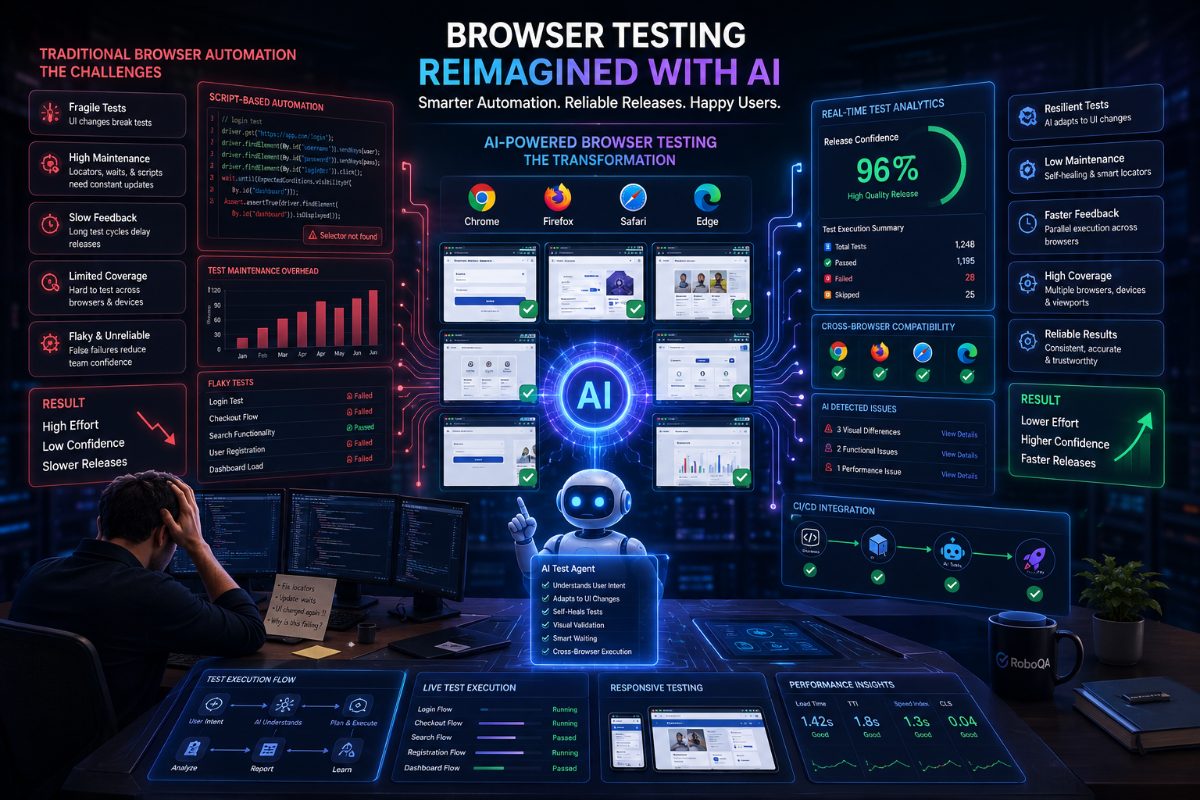
Why Traditional Browser Testing Breaks
Most browser automation relies on fixed instructions.
Click this button.
Enter this value.
Wait for this element.
Verify this text.
This approach works until the application changes.
A redesigned interface.
A renamed button.
A modified navigation menu.
A different loading animation.
The software still works.
The automation often doesn't.
Engineers spend valuable time fixing automation instead of improving software quality.
This maintenance burden grows as products become larger.
---
The Cost of Fragile Automation
Broken browser tests affect more than QA teams.
They delay releases.
Developers lose confidence in automation.
False failures consume engineering hours.
Manual verification increases.
Eventually, some teams stop trusting their automated test suites altogether.
Automation should accelerate delivery.
Instead, fragile automation can become another project requiring continuous maintenance.
---
Modern Browser Testing Requires Adaptability
Software doesn't remain static.
Neither should testing.
Modern browser testing must adapt to:
- UI improvements
- Responsive layouts
- Browser updates
- New user journeys
- Feature releases
- Component changes
The testing system itself should become more resilient to normal application evolution.
This is where AI introduces an entirely different approach.
---
How AI Makes Browser Testing More Reliable
Instead of depending entirely on rigid scripts, AI-powered browser testing focuses on user intent.
Rather than describing every mouse click and selector, testers define the objective.
Examples include:
"Verify a customer can successfully complete checkout."
"Ensure users can sign in using Google authentication."
"Validate product search returns relevant results."
The AI understands the testing objective.
It navigates the application.
Completes the workflow.
Collects evidence.
Highlights failures.
This significantly reduces repetitive scripting while improving testing flexibility.
---
Cross-Browser Testing Becomes Easier
One of the biggest browser testing challenges is consistency.
Applications must work across:
- Chrome
- Firefox
- Edge
- Safari
Each browser behaves slightly differently.
Rendering differences.
JavaScript execution.
CSS compatibility.
Responsive layouts.
Testing every browser manually quickly becomes impractical.
AI-powered browser testing helps teams validate important workflows across multiple browsers with far less effort.
---
Better Testing for Faster Releases
Software delivery is accelerating.
Engineering teams can't afford lengthy manual regression cycles before every deployment.
Reliable browser testing enables:
- Faster releases
- Earlier bug detection
- Higher confidence
- Better user experiences
When testing becomes more intelligent, software delivery becomes more predictable.
---
The Human Role Doesn't Disappear
AI doesn't replace quality engineers.
It amplifies them.
Engineers continue making quality decisions.
They design test strategies.
Identify business risks.
Explore edge cases.
Improve customer experience.
AI performs repetitive browser interactions.
Humans focus on quality.
That's where the greatest value exists.
---
How RoboQA Helps Teams Test Websites
RoboQA simplifies browser testing through AI-powered automation.
Instead of maintaining extensive browser automation scripts, teams describe the workflow they want to validate.
Examples include:
- Test user registration
- Verify checkout
- Validate login
- Check responsive navigation
- Confirm dashboard functionality
The AI agent executes browser interactions, captures evidence, detects issues, and generates comprehensive reports.
This allows engineering teams to spend less time maintaining automation and more time building better software.
---
The Future of Browser Testing
Browser testing isn't becoming less important.
It's becoming more important than ever.
Applications are growing.
Users expect flawless experiences.
Release cycles continue accelerating.
AI-powered browser testing represents the next evolution in software quality.
Rather than replacing existing automation, it enables engineering teams to test smarter, release faster, and maintain confidence throughout every deployment.
The future of browser testing isn't simply more automation.
It's more intelligent automation.
FAQ
Frequently Asked Questions
What is browser testing?
Browser testing verifies that a web application works correctly across different browsers, devices, and screen sizes to ensure users receive a consistent experience.
---
Why do browser automation tests fail?
Most browser automation relies on fixed selectors and predefined scripts. UI changes, browser updates, or modified workflows often cause automated tests to fail even when the application still works correctly.
---
What is AI browser testing?
AI browser testing uses artificial intelligence to understand testing goals, execute browser workflows, detect issues, and generate reports with less manual scripting.
---
Does AI replace Selenium or Playwright?
No.
AI complements traditional automation frameworks by reducing repetitive scripting and improving adaptability for browser-based testing.
---
How does RoboQA improve browser testing?
RoboQA allows QA teams to describe browser testing scenarios in natural language. The AI executes workflows, detects issues, captures evidence, and generates detailed reports to help teams release software faster.
RoboQA CTA
Test Your Website Smarter with RoboQA
Modern browser testing shouldn't require maintaining thousands of automation scripts.
RoboQA uses AI-powered browser automation to validate user journeys, detect issues, and generate detailed reports—helping engineering teams release software with greater confidence.
Start exploring AI-powered browser testing with RoboQA today.