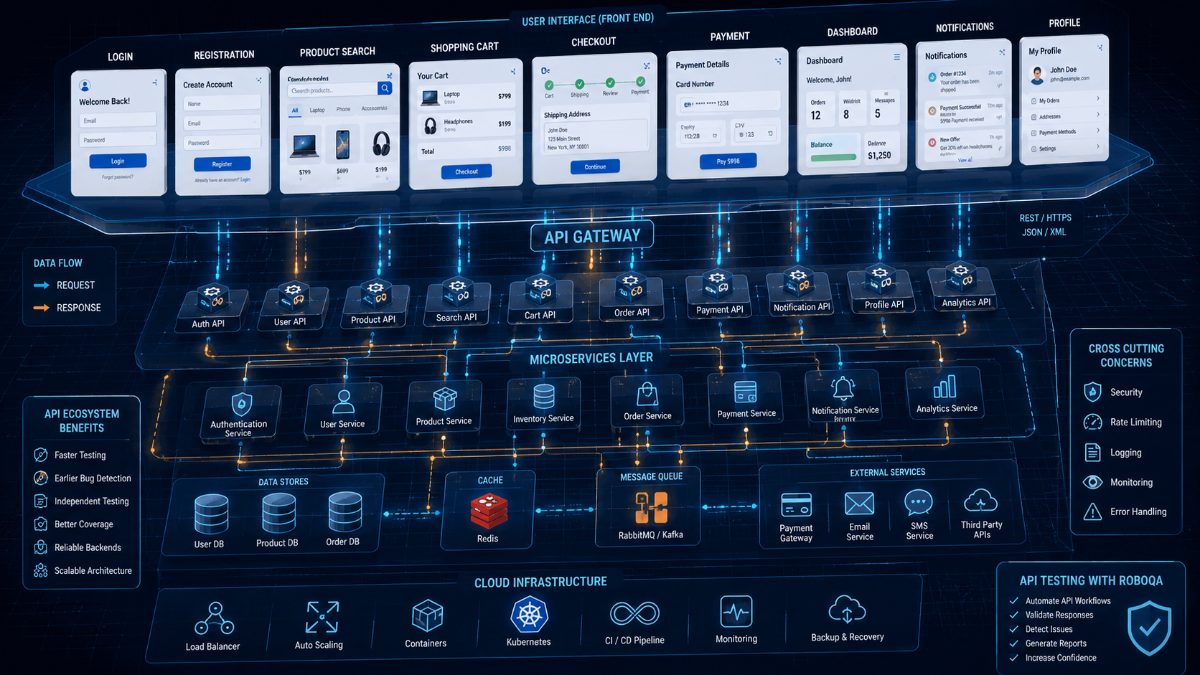
What Is API Testing?
Modern software isn't built as one giant application anymore.
Instead, today's applications are made up of dozens—or even hundreds—of APIs communicating behind the scenes.
When you log in to an application...
An API verifies your credentials.
When you search for products...
An API retrieves results from a database.
When you complete a payment...
Multiple APIs communicate with payment gateways, inventory systems, and notification services.
If any one of these APIs fails, the entire application can stop working—even if the user interface looks perfect.
That's why API Testing has become one of the most important parts of modern software testing.
---
What Is API Testing?
API Testing is the process of verifying that Application Programming Interfaces (APIs) work correctly, securely, reliably, and efficiently.
Unlike UI testing, API testing focuses on communication between software components rather than the visual interface.
It validates whether requests and responses behave as expected.
API testing answers questions like:
✔ Does the endpoint return the correct data?
✔ Does authentication work correctly?
✔ Are invalid requests handled properly?
✔ Does the API respond quickly?
✔ Is sensitive data protected?
---
Why API Testing Matters
Most modern applications rely heavily on APIs.
Examples include:
- Mobile applications
- SaaS platforms
- Banking systems
- Healthcare applications
- E-commerce websites
- Cloud services
- Microservice architectures
If an API breaks, multiple features may stop functioning at once.
For example:
A user successfully logs in.
But the Profile API fails.
The dashboard loads.
But the Product Search API returns an error.
Checkout opens.
But the Payment API times out.
Users don't know an API failed.
They only know the application stopped working.
---
Types of API Testing
Successful QA teams perform several kinds of API testing.
Functional Testing
Verifies that every endpoint returns the expected result.
Example:
GET /users
Returns:
- Status 200
- Correct user information
- Valid response format
---
Validation Testing
Confirms that APIs satisfy business requirements before release.
Example:
A coupon should only apply once.
The API must reject duplicate coupon usage.
---
Load Testing
Checks how APIs perform under heavy traffic.
Example:
10 users
100 users
1,000 users
10,000 users
Can the API still respond quickly?
---
Security Testing
Ensures APIs cannot be abused.
Tests include:
- Authentication
- Authorization
- SQL Injection
- Token validation
- Rate limiting
- Data exposure
---
Error Handling Testing
Verifies how APIs respond to invalid requests.
Example:
Missing parameters
Invalid IDs
Expired authentication tokens
Malformed JSON
A robust API returns meaningful error messages instead of crashing.
---
Common API Request Methods
The most frequently used HTTP methods include:
GET
Retrieve information.
Example:
Get Product List
---
POST
Create new resources.
Example:
Create User
---
PUT
Update an existing resource.
Example:
Update Profile
---
PATCH
Partially update data.
Example:
Change Password
---
DELETE
Remove resources.
Example:
Delete Account
---
API Testing vs UI Testing
| API Testing | UI Testing |
|-------------|------------|
| Tests backend logic | Tests user interface |
| Faster execution | Slower execution |
| Stable | More affected by UI changes |
| Easier automation | Higher maintenance |
| Validates business logic | Validates user experience |
Both approaches complement each other.
API testing ensures the system works.
UI testing ensures customers can use it.
---
Benefits of API Testing
API testing provides several advantages.
✔ Faster execution
✔ Early bug detection
✔ Better automation
✔ Improved reliability
✔ Easier regression testing
✔ Reduced testing costs
✔ Better software quality
---
Challenges of API Testing
Despite its benefits, API testing isn't always simple.
Common challenges include:
- Complex authentication
- Large API ecosystems
- Frequent API version changes
- Inconsistent documentation
- Third-party integrations
- Test data management
- Environment configuration
Without proper automation, maintaining hundreds of API tests becomes difficult.
---
Best Practices for API Testing
Successful QA teams follow these recommendations.
Test Positive and Negative Scenarios
Don't only verify successful requests.
Also validate invalid inputs.
---
Automate Repetitive Tests
Regression APIs should execute automatically after every deployment.
---
Validate Response Times
Performance matters.
A correct response arriving after 20 seconds is still a poor user experience.
---
Verify Response Structure
Ensure returned JSON matches expected schemas.
---
Include Security Checks
Always validate authentication, authorization, and sensitive data exposure.
---
How AI Is Transforming API Testing
Traditional API automation requires engineers to write extensive scripts.
AI introduces a much simpler workflow.
Instead of coding every request manually, QA engineers can describe the expected behavior using natural language.
For example:
"Verify users can register, authenticate, update their profile, and retrieve account information."
The AI automatically:
- Generates API requests
- Executes workflows
- Validates responses
- Detects failures
- Identifies unexpected behavior
- Produces detailed reports
This significantly reduces maintenance while increasing test coverage.
---
How RoboQA Simplifies API Testing
RoboQA helps teams validate modern applications using AI-powered testing.
Simply describe the expected behavior.
RoboQA can automatically:
- Validate application workflows
- Detect functional failures
- Execute browser-based user journeys
- Generate bug reports
- Capture evidence
- Produce release confidence scores
- Integrate into CI/CD pipelines
Combined with API validation strategies, RoboQA helps engineering teams release software faster with greater confidence.
---
Final Thoughts
APIs power nearly every modern application.
Whether users are logging in, making payments, searching products, or updating profiles, APIs are working behind the scenes.
Testing them thoroughly is essential for building reliable software.
As applications continue adopting microservices and cloud-native architectures, API Testing will remain one of the most valuable skills for QA engineers.
Combined with AI-powered automation, API testing is becoming faster, smarter, and significantly easier to maintain.
---
Frequently Asked Questions (FAQ)
What is API Testing?
API Testing verifies that application interfaces work correctly by validating requests, responses, business logic, security, and performance.
Why is API Testing important?
It detects backend issues before they reach users, improves software reliability, and supports faster releases.
Is API Testing faster than UI Testing?
Yes. Since it bypasses the graphical interface, API testing executes much faster and is generally more stable.
What tools are commonly used for API Testing?
Popular tools include Postman, Insomnia, REST Assured, SoapUI, JMeter, and AI-powered testing platforms.
Can API Testing be automated?
Absolutely. Most modern teams automate API regression tests as part of their CI/CD pipelines.