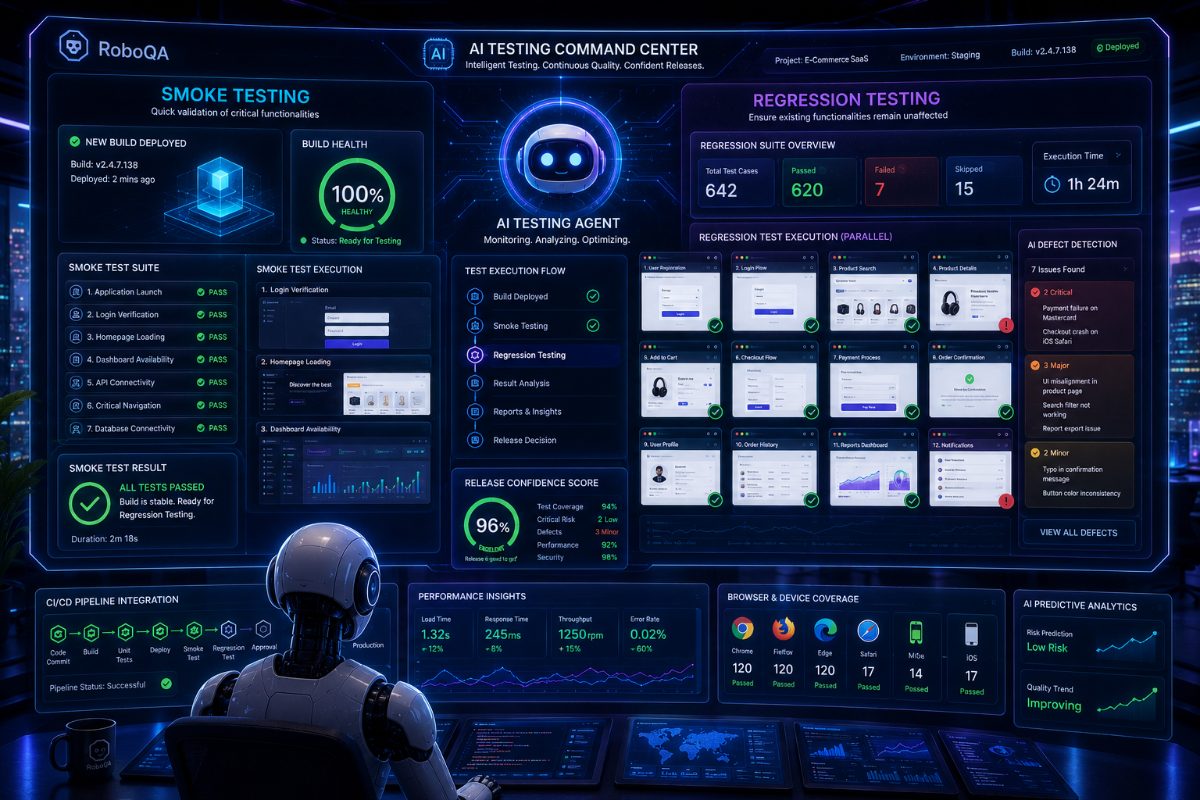
Smoke Testing vs Regression Testing: What's the Difference? (2026 Complete Guide)
One of the most common questions new QA engineers ask is:
"When should I perform Smoke Testing, and when should I perform Regression Testing?"
Although these testing approaches are often mentioned together, they solve very different problems.
Understanding the difference helps QA teams release software faster while reducing production defects.
In this guide, we'll explain Smoke Testing and Regression Testing, compare their objectives, provide practical examples, and explore how AI is transforming both processes.
---
What Is Smoke Testing?
Smoke Testing is the first validation performed after a new build is deployed.
Its purpose is simple:
Verify that the application is stable enough for deeper testing.
Think of Smoke Testing as a quick health check.
If the application fails Smoke Testing, there's no point continuing with detailed QA because the build itself isn't usable.
Smoke Testing answers one simple question:
"Is this build testable?"
---
Why Is It Called Smoke Testing?
The term comes from hardware engineering.
When engineers powered on a newly built electronic device, they checked whether smoke appeared.
If smoke came out...
The hardware clearly wasn't ready.
Software adopted the same idea.
A Smoke Test quickly confirms that the application starts correctly before investing additional testing effort.
---
What Does Smoke Testing Usually Cover?
Smoke Testing focuses on critical functionality.
Typical scenarios include:
- Application launches successfully
- Login works
- Dashboard loads
- Navigation functions correctly
- APIs respond
- Search opens
- Basic database connectivity works
- Core pages load without errors
The goal isn't complete validation.
It's simply ensuring the product is stable enough for further testing.
---
Example of Smoke Testing
Imagine you're testing an eCommerce website.
A Smoke Test might verify:
✔ Homepage loads
✔ User Login
✔ Product Search
✔ Product Page opens
✔ Add to Cart works
✔ Checkout page opens
If any of these fail...
The build is rejected immediately.
No additional testing begins.
---
What Is Regression Testing?
Regression Testing is much broader.
Instead of validating whether a build is usable, Regression Testing ensures that existing functionality still works after recent code changes.
Every software update introduces risk.
A developer fixes one issue.
Another feature unexpectedly breaks.
Regression Testing protects against these side effects.
---
Why Regression Testing Is Essential
Modern software applications contain thousands of interconnected components.
A small UI change can affect:
- Authentication
- Checkout
- User Profiles
- Reports
- Notifications
- APIs
Regression Testing identifies these unexpected failures before customers discover them.
---
Example of Regression Testing
Suppose developers improve the checkout page.
Regression Testing should verify:
- Login
- Registration
- Search
- Cart
- Coupons
- Checkout
- Payment
- Order History
- User Profile
- Notifications
Even though only checkout changed, every related workflow should continue functioning correctly.
---
Smoke Testing vs Regression Testing
| Smoke Testing | Regression Testing |
|---------------|-------------------|
| Quick validation | Comprehensive validation |
| Performed after every build | Performed after code changes |
| Small test suite | Large test suite |
| Confirms build stability | Confirms existing features still work |
| Takes minutes | Can take hours |
| Stops testing if it fails | Continues after Smoke Test passes |
Both are essential.
Neither replaces the other.
Instead, they work together to improve software quality.
---
When Should Smoke Testing Be Performed?
Smoke Testing should run:
- After every deployment
- After new builds
- Before detailed QA
- Before Regression Testing
- Before User Acceptance Testing (UAT)
Its goal is to quickly reject unstable builds.
---
When Should Regression Testing Be Performed?
Regression Testing should run:
- Before every release
- After bug fixes
- After feature development
- Before production deployment
- During CI/CD pipelines
Comprehensive regression testing provides confidence that existing functionality remains intact.
---
Can Smoke Testing Be Automated?
Absolutely.
Smoke Tests are ideal candidates for automation because they are:
- Short
- Repetitive
- Critical
- Frequently executed
Automated Smoke Testing enables development teams to receive rapid feedback whenever a new build is deployed.
---
AI Is Changing Smoke and Regression Testing
Traditionally, QA engineers wrote Selenium or Playwright scripts to automate Smoke and Regression Testing.
While effective, maintaining these scripts requires continuous effort.
AI-powered testing introduces a new approach.
Instead of writing automation code, QA engineers describe test scenarios in natural language.
The AI understands the workflow, performs browser interactions, validates expected behaviour, captures screenshots, identifies bugs, and generates reports automatically.
This dramatically reduces maintenance while accelerating release validation.
---
How RoboQA Helps
RoboQA combines AI with browser automation to simplify Smoke Testing and Regression Testing.
Simply describe your testing objective.
The AI automatically:
- Executes browser workflows
- Validates user journeys
- Detects failures
- Captures screenshots
- Generates reports
- Measures performance
- Produces release confidence scores
Instead of maintaining thousands of fragile automation scripts, teams can focus on improving software quality.
---
Final Thoughts
Smoke Testing and Regression Testing serve different purposes, but together they create a strong quality assurance strategy.
Smoke Testing confirms that a build is stable enough for testing.
Regression Testing ensures recent changes haven't broken existing functionality.
Modern AI-powered testing platforms make both processes faster, more scalable, and significantly easier to maintain.
Engineering teams that combine structured testing with AI automation can release software more frequently without sacrificing quality.
FAQ
Frequently Asked Questions
What is Smoke Testing?
Smoke Testing is a quick verification process performed after a new software build is deployed. It ensures that the application's most important features work correctly before detailed testing begins.
---
What is Regression Testing?
Regression Testing verifies that existing functionality continues working after new code changes, bug fixes, or feature additions.
---
Which comes first: Smoke Testing or Regression Testing?
Smoke Testing always comes first.
If the Smoke Test fails, Regression Testing usually isn't performed because the build isn't stable enough for deeper validation.
---
Is Smoke Testing part of Regression Testing?
No.
They are different testing activities with different objectives.
Smoke Testing checks whether a build is stable.
Regression Testing checks whether recent changes have broken existing functionality.
---
Can AI automate Smoke Testing?
Yes.
AI-powered testing platforms can automatically execute Smoke Test scenarios, validate browser workflows, capture screenshots, detect failures, and generate reports without requiring extensive automation scripts.
---
How does RoboQA help?
RoboQA enables QA teams to describe testing scenarios in natural language. The AI agent executes browser automation, validates workflows, detects issues, captures evidence, and generates comprehensive testing reports automatically.
RoboQA CTA
Stop Maintaining Fragile Automation Scripts
Modern QA teams shouldn't spend hours updating Selenium scripts every sprint.
With RoboQA you simply describe what needs testing.
The AI automatically:
✔ Executes browser workflows
✔ Performs Smoke Testing
✔ Runs Regression Testing
✔ Detects UI bugs
✔ Captures screenshots
✔ Generates reports
✔ Calculates release confidence
Ship faster with AI-powered browser testing.