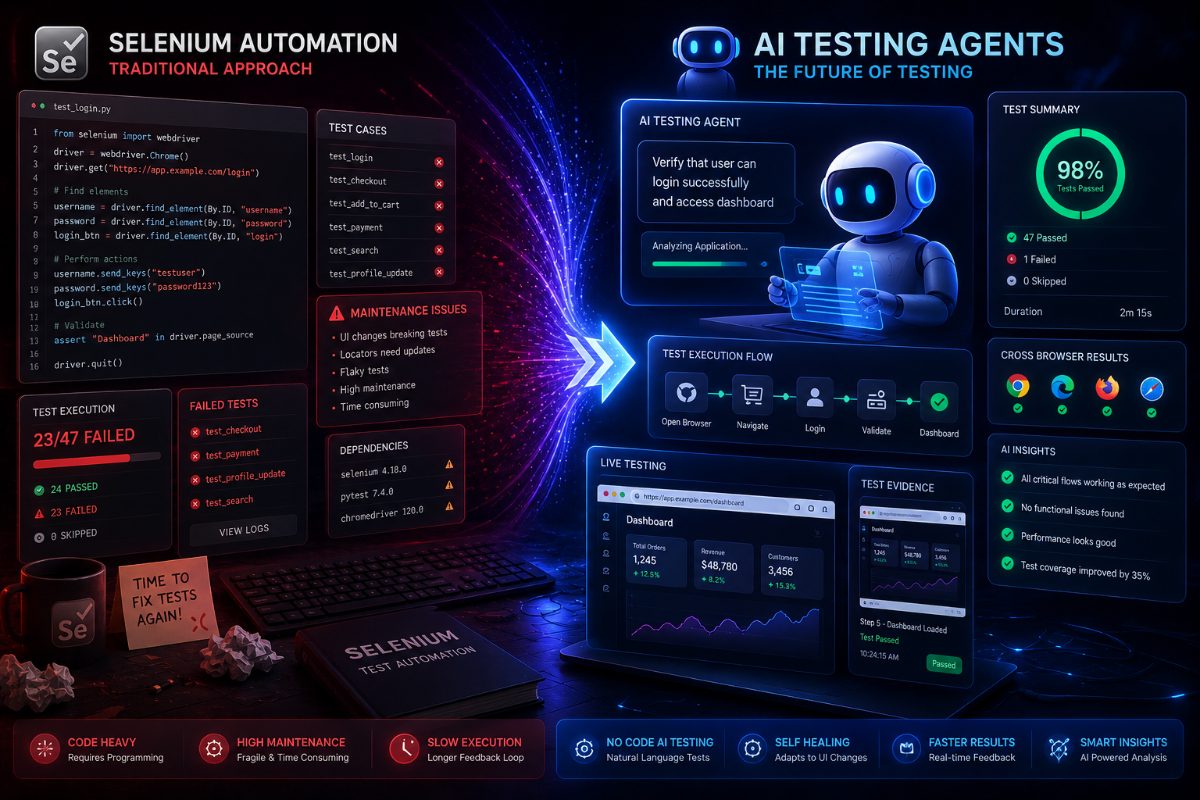
Selenium vs AI Testing Agents: Which Approach Is Better in 2026?
Selenium changed software testing forever.
When browser automation became accessible, QA teams could move away from repetitive manual testing and create automated workflows.
For years, Selenium became one of the most popular choices for web automation.
Teams around the world used it to automate:
- Login flows
- Checkout journeys
- Form validations
- Regression testing
- User workflows
But software development has changed.
Applications are becoming more dynamic.
Release cycles are becoming faster.
User journeys are becoming more complex.
And a new question is emerging:
Is traditional browser automation enough for modern applications?
This is where AI testing agents are entering the conversation.
---
Understanding Selenium Automation
Selenium is a browser automation framework that allows testers and developers to control web browsers programmatically.
A typical Selenium workflow looks like this:
1. Open browser
2. Navigate to page
3. Find elements
4. Perform actions
5. Validate results
Example:
"Open login page, enter username, enter password, click login, verify dashboard."
This approach is powerful because it provides complete control.
Teams can create detailed automated test suites.
---
Why Selenium Became So Popular
Selenium solved an important problem.
Before browser automation, testers had to manually repeat the same workflows.
Selenium provided:
- Browser control
- Cross-browser testing
- Programming flexibility
- Large community support
- Integration with CI/CD pipelines
Many companies still depend on Selenium today.
---
The Challenge With Selenium Today
The biggest challenge with Selenium is not creating tests.
The challenge is maintaining them.
Modern applications change frequently.
A small update can break multiple tests.
Examples:
A button name changes.
A page structure changes.
A component is redesigned.
A workflow receives an extra step.
The application may work perfectly.
But the automation script fails.
QA teams then spend time repairing automation instead of improving quality.
---
What Are AI Testing Agents?
AI testing agents represent a different approach.
Instead of focusing only on instructions, AI agents focus on goals.
Traditional automation:
"Click this button.
Enter this value.
Verify this element."
AI testing:
"Verify that customers can complete checkout successfully."
The system understands the objective and attempts to complete the workflow.
---
How AI Testing Agents Work
AI-powered testing systems can help with:
Understanding User Intent
Instead of requiring every technical step, testers can describe scenarios naturally.
Example:
"Test the registration process for a new user."
---
Exploring User Journeys
AI agents can navigate applications and validate workflows.
Examples:
- Registration
- Login
- Search
- Checkout
- Navigation
---
Generating Testing Evidence
Modern AI testing tools can provide:
- Test results
- Screenshots
- Execution details
- Failure information
---
Selenium vs AI Testing Agents
Selenium
Advantages:
- Mature technology
- Large ecosystem
- Complete technical control
- Reliable for structured testing
Challenges:
- Requires coding knowledge
- Tests need maintenance
- UI changes can break scripts
- Creating tests takes time
AI Testing Agents
Advantages:
- Natural language testing
- Faster workflow creation
- Less repetitive scripting
- Better suited for changing interfaces
Challenges:
- New technology
- Requires evaluation
- Not every testing scenario fits AI approaches
---
Should Teams Replace Selenium With AI Testing?
The answer is not simply yes or no.
Selenium is still valuable.
Many teams will continue using traditional automation frameworks.
The future is likely a combination.
Use traditional automation when:
- You need highly controlled workflows
- You have stable applications
- You require deep technical customization
Use AI testing when:
- Applications change frequently
- You need faster test creation
- You want to validate user journeys
- You want less script maintenance
---
The Future Is Hybrid Testing
The future of QA will not be about replacing existing tools.
It will be about choosing the right approach.
A modern testing strategy may include:
Traditional automation.
AI-powered testing agents.
Manual exploratory testing.
Together, these approaches create stronger quality processes.
---
How RoboQA Approaches AI Testing
RoboQA focuses on making browser testing easier.
Instead of writing detailed automation scripts, teams can describe what they want to test.
Examples:
"Verify user login."
"Test checkout after applying a discount."
"Check navigation across the website."
The AI agent executes browser workflows and generates testing insights.
---
Final Thoughts
Selenium created the foundation of browser automation.
AI testing agents represent the next evolution.
The future of software testing is not humans versus automation.
It is engineers using smarter automation tools.
Teams that combine human expertise with AI capabilities will be able to test faster, release confidently, and build better software.
RoboQA CTA
RoboQA helps teams automate browser testing using AI-powered workflows.
Describe your testing scenario in simple language and let AI execute the browser workflow, validate results, and generate insights.
Build faster testing workflows with RoboQA.