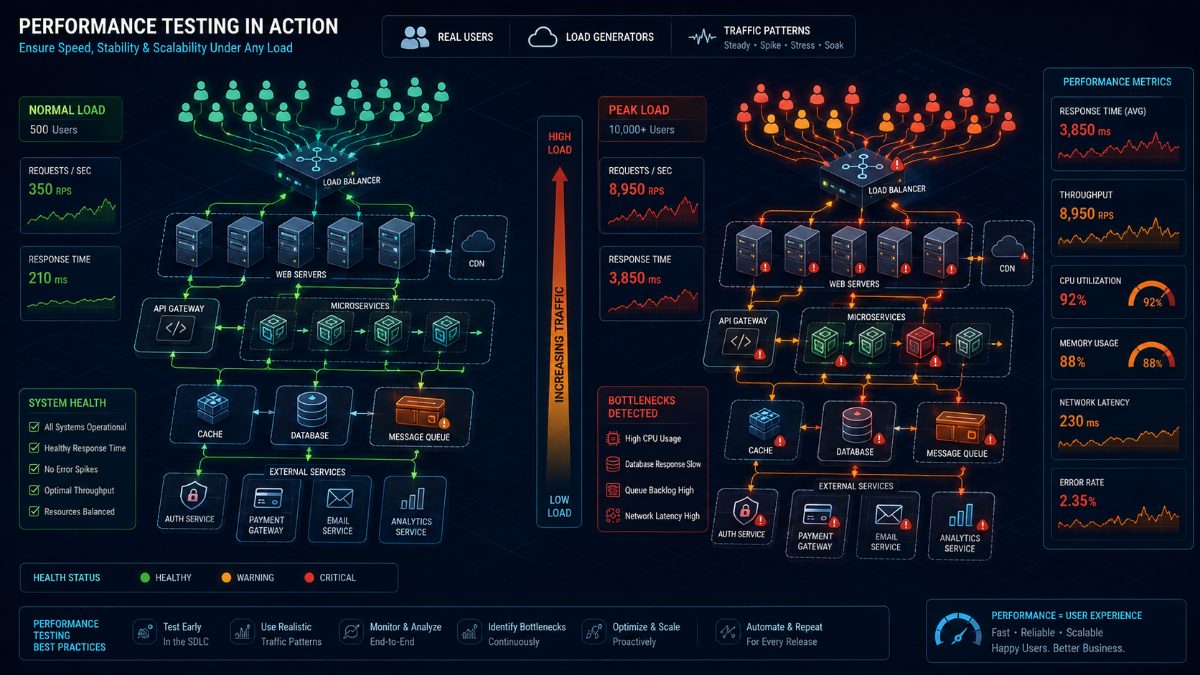
Why Performance Matters More Than Ever
Users today have almost zero patience.
If a website takes five seconds to load...
Many users leave.
If checkout freezes...
Sales disappear.
If APIs become slow...
Entire business operations stop.
Modern users don't compare your application with your competitors.
They compare it with the fastest applications they use every day.
That's why Performance Testing has become a critical part of software quality.
A feature that works correctly but responds slowly is still considered broken by users.
---
What Is Performance Testing?
Performance Testing evaluates how fast, stable, scalable, and reliable an application performs under different workloads.
Unlike Functional Testing, which verifies what the application does, Performance Testing measures how well it performs.
It answers questions such as:
✔ How fast does the application respond?
✔ How many users can it support?
✔ Does performance degrade under heavy traffic?
✔ Does the system remain stable?
✔ Where are the bottlenecks?
---
Why Performance Testing Matters
Performance issues directly affect business success.
Slow software leads to:
- Poor customer experience
- Lost revenue
- Higher bounce rates
- Lower search rankings
- Reduced customer trust
- Increased infrastructure costs
Even a one-second delay in page response can significantly reduce conversions.
Performance is no longer just an engineering metric.
It's a business metric.
---
Types of Performance Testing
Different testing methods evaluate different aspects of application performance.
Load Testing
Measures application behavior under expected user traffic.
Example:
Can an eCommerce website handle 5,000 simultaneous shoppers during a seasonal sale?
---
Stress Testing
Pushes the application beyond its normal capacity.
Purpose:
Discover the breaking point.
Questions answered:
- When does the application fail?
- Does it recover gracefully?
---
Spike Testing
Simulates sudden traffic surges.
Example:
A flash sale starts.
Traffic jumps from 500 users to 25,000 users within minutes.
Can the system survive?
---
Endurance Testing
Also called Soak Testing.
Runs the application continuously for several hours or days.
Purpose:
Identify memory leaks, resource exhaustion, and gradual performance degradation.
---
Volume Testing
Evaluates how the system performs when processing very large amounts of data.
Example:
Millions of customer records.
Large databases.
Massive reports.
---
Scalability Testing
Measures how efficiently an application grows as traffic increases.
Can additional servers improve performance?
Or does the architecture become the bottleneck?
---
Common Performance Metrics
QA teams monitor several important metrics.
✔ Response Time
✔ Throughput
✔ Requests Per Second
✔ CPU Usage
✔ Memory Consumption
✔ Database Performance
✔ Network Latency
✔ Error Rate
✔ Concurrent Users
Together, these metrics provide a complete view of system health.
---
Performance Testing vs Load Testing
Many people use these terms interchangeably.
They're not the same.
| Performance Testing | Load Testing |
|--------------------|--------------|
| Overall performance evaluation | Expected workload testing |
| Multiple testing types | One type of performance testing |
| Includes stress, endurance, scalability | Focuses on normal traffic |
| Broad strategy | Specific technique |
Load Testing is a subset of Performance Testing.
---
Common Performance Testing Scenarios
Examples include:
✔ Website Homepage
✔ Login APIs
✔ Product Search
✔ Shopping Cart
✔ Checkout
✔ Payment Gateway
✔ File Upload
✔ Report Generation
✔ Dashboard Loading
✔ Mobile APIs
Every critical business workflow should be tested under realistic traffic.
---
Challenges of Performance Testing
Performance testing isn't always straightforward.
Common challenges include:
- Creating realistic traffic
- Large infrastructure costs
- Environment differences
- Third-party service limitations
- Database bottlenecks
- Monitoring distributed systems
- Cloud scalability
Without proper planning, results may not reflect real-world usage.
---
Best Practices
Successful engineering teams follow these principles.
Test Early
Performance should be validated throughout development—not just before release.
---
Use Realistic Workloads
Traffic patterns should resemble actual user behavior.
---
Monitor Infrastructure
Applications rarely fail alone.
Servers, databases, caches, and networks all contribute to performance.
---
Test Critical Business Flows
Focus on:
- Login
- Search
- Checkout
- Payments
- User dashboards
---
Automate Performance Tests
Include performance testing within CI/CD pipelines whenever possible.
Early detection prevents expensive production issues.
---
How AI Is Transforming Performance Testing
Traditional performance testing often requires extensive scripting, traffic modeling, and infrastructure setup.
AI simplifies much of this work.
Instead of manually configuring thousands of virtual users, AI can:
- Generate realistic traffic patterns
- Identify bottlenecks automatically
- Detect unusual response behavior
- Predict future scalability issues
- Recommend infrastructure improvements
- Prioritize critical performance failures
This enables teams to optimize applications much faster.
---
How RoboQA Helps Engineering Teams
RoboQA uses AI-powered browser testing to validate software quality before every release.
Combined with performance testing strategies, RoboQA helps teams:
- Detect functional failures
- Validate user journeys
- Generate detailed bug reports
- Capture testing evidence
- Measure release confidence
- Integrate testing into CI/CD pipelines
Engineering teams spend less time maintaining automation and more time delivering reliable software.
---
Final Thoughts
Fast software wins.
Users expect instant responses, smooth interactions, and reliable performance regardless of traffic.
Performance Testing ensures applications remain stable as usage grows.
Combined with AI-powered quality engineering, Performance Testing is becoming smarter, faster, and easier to automate.
In 2026 and beyond, performance will be one of the strongest competitive advantages any software team can build.
---
Frequently Asked Questions (FAQ)
What is Performance Testing?
Performance Testing measures how fast, stable, scalable, and reliable an application performs under different workloads.
What is the difference between Performance Testing and Load Testing?
Load Testing evaluates expected traffic levels, while Performance Testing includes load, stress, spike, endurance, scalability, and volume testing.
Why is Performance Testing important?
It identifies bottlenecks before users experience slow applications, improving customer satisfaction and reducing business risk.
Which tools are used for Performance Testing?
Popular tools include Apache JMeter, k6, Gatling, Locust, BlazeMeter, LoadRunner, and modern AI-powered testing platforms.
Can Performance Testing be automated?
Yes. Most organizations automate performance testing as part of continuous integration and continuous delivery pipelines.