AI Test Case Generation Explained: How Artificial Intelligence Is Transforming Software Testing
For decades, writing test cases has been one of the most time-consuming activities in software testing.
Every new feature requires QA engineers to analyze requirements, identify possible user journeys, think about edge cases, document expected behavior, and continuously update test cases as the application evolves.
While this process is essential for delivering quality software, it often becomes repetitive, difficult to maintain, and expensive as products grow.
Artificial Intelligence is changing that.
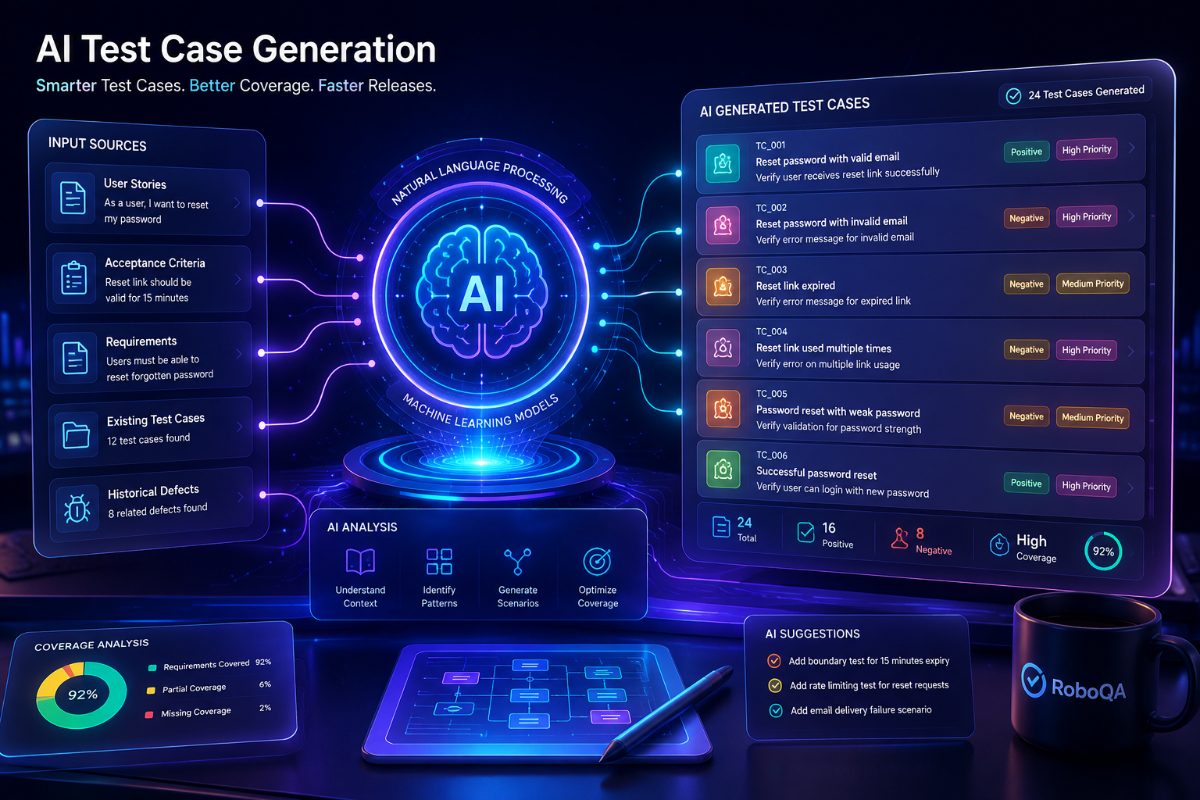
AI Test Case Generation enables software teams to automatically create meaningful test cases from business requirements, user stories, application behavior, historical defects, and even natural language prompts.
Instead of spending hours writing repetitive test documentation, QA teams can now focus on validating business value, exploring edge cases, and improving product quality.
In this guide, we'll explore how AI Test Case Generation works, its benefits, real-world use cases, best practices, and why it is becoming a core capability of modern QA teams.
---
What Is AI Test Case Generation?
AI Test Case Generation is the process of using artificial intelligence to automatically create software test cases based on application requirements, user stories, acceptance criteria, existing documentation, or observed user behavior.
Rather than manually documenting every validation step, AI understands the business context and produces structured test scenarios that engineers can review, refine, and execute.
The objective is simple:
Create higher-quality test cases in less time while improving overall test coverage.
---
Why Traditional Test Case Writing Is Challenging
Most software teams face similar problems.
Requirements change frequently.
Features evolve.
Acceptance criteria expand.
Business rules become more complex.
As products grow, manually maintaining thousands of test cases quickly becomes a major bottleneck.
Common challenges include:
- Repetitive documentation
- Human error
- Missing edge cases
- Inconsistent formatting
- Outdated test suites
- High maintenance costs
These issues often slow releases and reduce confidence in software quality.
---
How AI Generates Test Cases
Modern AI systems analyze multiple sources of information, including:
- Product requirements
- User stories
- Acceptance criteria
- Functional specifications
- Existing regression suites
- Application workflows
- Historical defects
- Business rules
The AI identifies expected behaviors and automatically generates structured test scenarios.
For example, given a simple user story:
"Users should be able to reset their password."
AI can instantly generate dozens of test cases covering:
- Successful password reset
- Invalid email address
- Expired reset links
- Weak password validation
- Locked accounts
- Multiple reset requests
- Email delivery failures
- Security validations
- Session expiration
- Rate limiting
Instead of writing one or two tests manually, QA engineers receive a comprehensive starting point within seconds.
---
Benefits of AI Test Case Generation
Faster Test Design
AI dramatically reduces the time required to prepare functional and regression test suites.
Improved Test Coverage
Artificial intelligence identifies scenarios that human testers may overlook, including negative tests, edge cases, and uncommon workflows.
Standardized Documentation
Automatically generated test cases follow consistent formatting, making them easier to review and maintain.
Reduced Manual Effort
QA engineers spend less time writing repetitive documentation and more time validating application quality.
Better Collaboration
Well-structured AI-generated test cases improve communication between QA engineers, developers, product managers, and business analysts.
---
Real-World Example
Imagine an online shopping application introducing a new coupon feature.
Instead of manually creating dozens of test cases, an AI system can automatically generate scenarios such as:
- Apply valid coupon
- Apply expired coupon
- Invalid coupon code
- Multiple coupons together
- Coupon with free shipping
- Coupon exceeding cart value
- Coupon removal
- Guest checkout validation
- Logged-in customer validation
- Mobile browser validation
Within minutes, QA teams have a complete foundation for testing the feature.
---
AI Does Not Replace QA Engineers
One common misconception is that AI eliminates the need for manual testing.
It doesn't.
AI accelerates documentation and suggests intelligent scenarios, but experienced QA engineers still review business logic, prioritize risks, validate edge cases, and ensure generated test cases align with product goals.
AI becomes an assistant—not a replacement.
---
Best Practices
- Review AI-generated test cases before execution.
- Combine AI with exploratory testing.
- Keep business requirements up to date.
- Continuously refine prompts and documentation.
- Use AI to strengthen regression coverage rather than replace human judgment.
---
Why This Matters for AI-Powered Testing
Traditional test case creation struggles to keep pace with modern agile development. As features are released more frequently, manually updating hundreds of test cases becomes increasingly difficult.
AI-powered test case generation helps QA teams adapt by creating comprehensive test scenarios in seconds, improving consistency, and ensuring better coverage without increasing manual effort. This allows engineering teams to spend more time validating product quality and less time writing documentation.
---
Why QA Teams Choose RoboQA
RoboQA extends AI beyond simple automation by helping teams generate meaningful test scenarios from natural language requirements.
Using RoboQA, QA engineers can:
- Create test cases from feature descriptions
- Generate positive and negative scenarios
- Expand regression coverage
- Identify missing validation points
- Accelerate release readiness
Instead of starting with a blank document, teams begin with AI-assisted testing intelligence that speeds up the entire QA lifecycle.
---
Final Thoughts
AI Test Case Generation represents one of the most practical applications of artificial intelligence in software testing.
Rather than replacing QA engineers, it empowers them to work faster, think deeper, and focus on delivering better software.
As software continues to evolve, AI-assisted test design will become an essential capability for modern engineering teams.
FAQ
Q. What is AI Test Case Generation?
AI Test Case Generation uses artificial intelligence to automatically create structured software test cases from requirements, user stories, and application behavior.
Q. Can AI replace manual test case writing?
No. AI accelerates creation, but QA engineers should always review and refine generated test cases.
Q. Does AI improve test coverage?
Yes. AI can identify positive, negative, boundary, and edge-case scenarios that may otherwise be missed.
Q. Is AI Test Case Generation useful for Agile teams?
Absolutely. It helps teams keep pace with rapidly changing requirements while reducing documentation effort.
Q. How does RoboQA help with AI Test Case Generation?
RoboQA enables QA teams to generate intelligent test scenarios from natural language requirements, improving speed, consistency, and overall software quality.