AI Regression Testing: The Complete Guide to Smarter Software Regression Testing (2026)
Regression testing has always been one of the most important—and time-consuming—activities in software development.
Every time developers fix a bug, release a feature, update a dependency, or deploy a new version, QA teams need to ensure that existing functionality still works exactly as expected.
This process protects customers from unexpected regressions and gives engineering teams confidence before releasing software into production.
But as applications grow larger and release cycles become faster, traditional regression testing becomes increasingly difficult to maintain.
Artificial Intelligence is changing that.
AI Regression Testing enables software teams to intelligently select, execute, analyze, and optimize regression tests while reducing maintenance and improving software quality.
Instead of simply rerunning every automated test after every deployment, AI helps engineering teams focus on the tests that matter most.
In this guide, you'll learn how AI Regression Testing works, why modern engineering organizations are adopting it, and how it is reshaping software quality.
---
What Is AI Regression Testing?
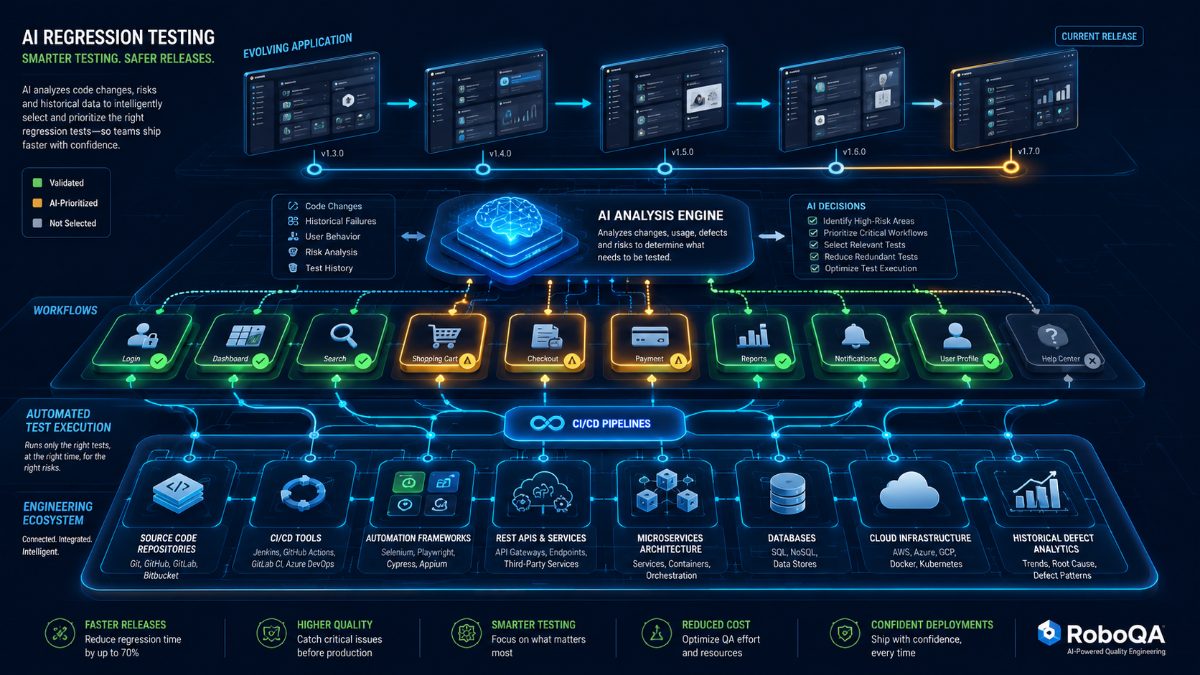
AI Regression Testing uses artificial intelligence to automatically identify, prioritize, execute, and analyze regression test suites based on application changes, historical defects, user behavior, and software risk.
Traditional regression testing executes predefined tests.
AI goes further by understanding which areas of the application are most likely to be affected by recent changes.
The goal is simple:
Deliver faster releases with higher confidence while reducing unnecessary testing effort.
---
Why Traditional Regression Testing Becomes Difficult
Modern SaaS applications change constantly.
A single sprint may include:
- New features
- Bug fixes
- API updates
- UI improvements
- Security patches
- Infrastructure changes
Many organizations respond by running their complete regression suite after every release.
While this increases confidence, it also introduces problems:
- Long execution times
- Flaky automation
- High maintenance costs
- Duplicate test coverage
- Delayed deployments
As regression suites grow into thousands of test cases, maintaining them becomes one of the largest QA challenges.
---
How AI Improves Regression Testing
Artificial intelligence continuously analyzes:
- Source code changes
- User behavior
- Feature usage
- Historical failures
- Defect trends
- Test execution history
- Risk levels
Using this information, AI can:
- Recommend which regression tests should run first
- Identify outdated tests
- Detect redundant test cases
- Predict high-risk modules
- Reduce unnecessary executions
Instead of treating every test equally, AI prioritizes testing based on business impact and software risk.
---
Benefits of AI Regression Testing
Faster Regression Cycles
AI selects the most relevant regression tests instead of executing every test after every deployment.
Better Test Coverage
Risk-based prioritization improves defect detection while minimizing redundant execution.
Reduced Maintenance
AI adapts more effectively to changing applications, reducing the effort required to maintain regression suites.
Higher Release Confidence
Engineering teams deploy more frequently without sacrificing software quality.
Improved Developer Productivity
Developers receive faster feedback, allowing defects to be fixed earlier in the development lifecycle.
---
Real-World Example
Imagine an eCommerce platform updating its payment gateway.
Traditional regression testing may execute thousands of unrelated tests.
AI identifies that the highest-risk areas include:
- Checkout
- Payment
- Shopping Cart
- Discounts
- Order Confirmation
- Invoice Generation
The regression suite focuses on these workflows first, reducing execution time while maintaining confidence.
---
Best Practices
- Execute regression tests continuously through CI/CD.
- Prioritize business-critical workflows.
- Monitor flaky tests regularly.
- Combine AI insights with exploratory testing.
- Review regression coverage after every release.
---
Why This Matters for AI-Powered Testing
As software delivery accelerates, regression testing must become smarter—not simply larger.
AI helps organizations move from "test everything" to "test intelligently," improving quality while reducing execution time.
---
Why QA Teams Choose RoboQA
RoboQA combines intelligent browser testing, AI-powered regression analysis, automated bug detection, and release validation into one platform.
Rather than maintaining massive regression suites manually, QA teams can focus on shipping reliable software faster.
---
Final Thoughts
Regression testing isn't disappearing.
It's evolving.
Artificial Intelligence allows QA teams to execute smarter regression strategies that improve quality while accelerating software delivery.
For modern engineering teams, AI Regression Testing is quickly becoming a competitive advantage.