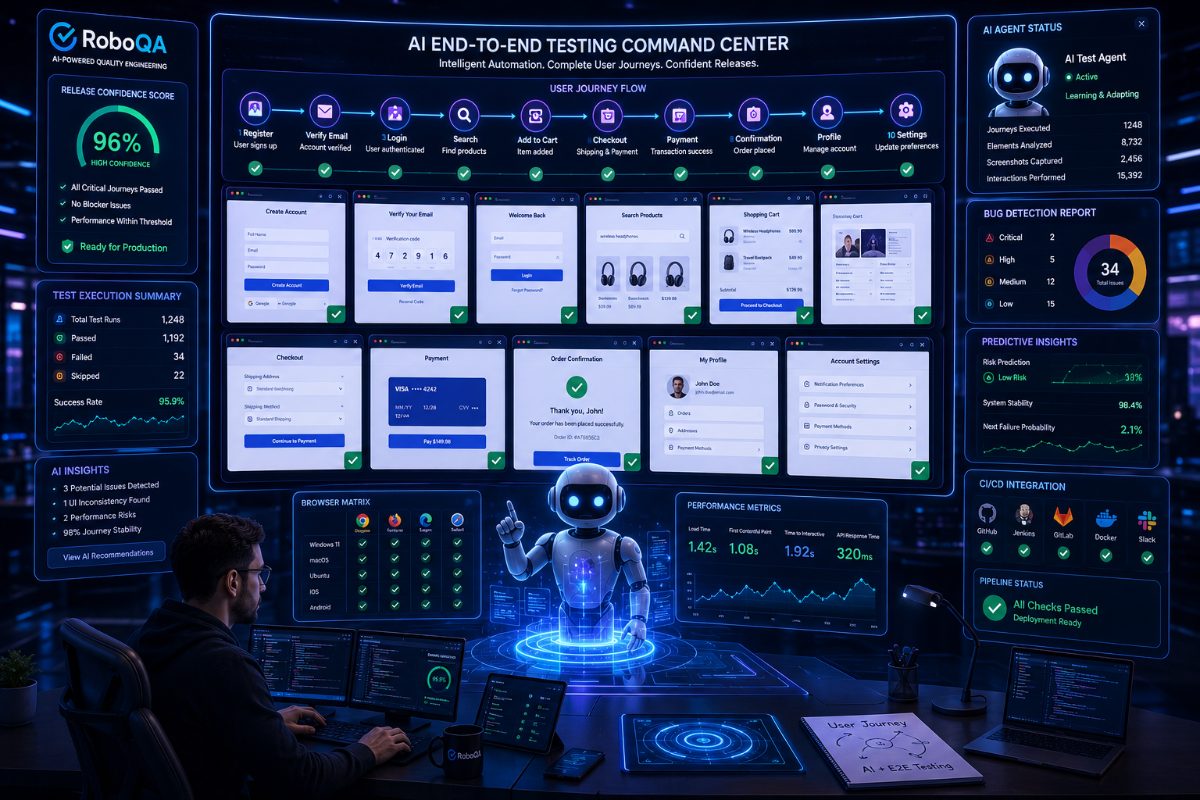
End-to-End Testing with AI: The Future of Complete User Journey Automation
Modern software is no longer a collection of individual pages.
Today's applications are complete user experiences.
A customer signs up.
Logs in.
Searches for products.
Adds items to a cart.
Applies a coupon.
Makes a payment.
Receives an order confirmation.
Every one of these actions forms part of a larger user journey.
If any single step fails, the entire experience breaks.
That's why End-to-End (E2E) testing has become one of the most important aspects of software quality.
But as applications become larger and releases become faster, traditional end-to-end testing is reaching its limits.
AI-powered testing is introducing a new approach—one focused on user goals rather than scripts.
Let's explore why this matters.
---
What Is End-to-End Testing?
End-to-End (E2E) testing verifies that an entire business workflow functions correctly from start to finish.
Unlike unit testing or integration testing, E2E testing validates the complete experience from the user's perspective.
For example, an e-commerce website may include this journey:
- User registration
- Email verification
- Login
- Product search
- Add to cart
- Apply coupon
- Checkout
- Payment
- Order confirmation
If even one step fails, customers may abandon the purchase.
End-to-end testing ensures the entire workflow works exactly as intended.
---
Why End-to-End Testing Is Difficult
As products evolve, user journeys become more complex.
Applications integrate with:
- Payment gateways
- Authentication providers
- Third-party APIs
- Notification systems
- Recommendation engines
- Analytics platforms
Every integration increases testing complexity.
One broken API.
One modified UI element.
One unexpected timeout.
The complete user journey may fail.
Maintaining comprehensive end-to-end tests becomes increasingly expensive.
---
The Challenges of Traditional E2E Automation
Frameworks like Selenium and Playwright have made browser automation significantly easier.
However, end-to-end testing introduces unique challenges.
Automation scripts become longer.
Dependencies increase.
Small UI changes break multiple workflows.
Test execution slows as suites grow.
False failures reduce confidence.
Eventually, engineering teams spend more time maintaining automation than expanding test coverage.
---
Why AI Changes End-to-End Testing
AI shifts the focus from browser commands to business objectives.
Instead of scripting every interaction, QA engineers define the workflow they want to validate.
Examples include:
"Verify a customer can complete checkout."
"Test password reset using a registered email."
"Ensure a new user can create an account and access the dashboard."
The AI understands the objective.
It interacts with the application.
Makes decisions during execution.
Detects failures.
Captures screenshots.
Generates reports.
This dramatically reduces repetitive scripting while improving testing flexibility.
---
Advantages of AI End-to-End Testing
Faster Test Creation
Complex workflows can be created in minutes instead of hours.
---
Reduced Maintenance
AI adapts better to normal UI evolution than rigid scripts.
---
Better Coverage
Teams can validate more customer journeys before every release.
---
Continuous Validation
AI-powered workflows integrate naturally into CI/CD pipelines.
Every deployment can validate critical business scenarios automatically.
---
Improved QA Productivity
Engineers spend less time maintaining scripts and more time:
- Exploring edge cases
- Improving user experience
- Performing risk analysis
- Finding meaningful defects
---
Real-World Example
Imagine an online retail platform preparing for a Black Friday sale.
Critical workflows include:
- User registration
- Login
- Product search
- Shopping cart
- Coupon validation
- Payment processing
- Order confirmation
Testing these manually before every deployment could take several hours.
With AI-powered end-to-end testing, these workflows execute automatically after every build.
Issues are detected before customers experience them.
---
How RoboQA Simplifies End-to-End Testing
RoboQA allows engineering teams to automate browser-based user journeys using AI.
Instead of writing lengthy automation scripts, teams simply describe the workflow.
Examples:
- Test complete checkout flow.
- Verify new user registration.
- Validate login with Google authentication.
- Confirm order placement.
- Check profile update functionality.
The AI agent executes each workflow, captures evidence, identifies failures, and generates detailed reports.
Teams spend less time maintaining automation and more time improving software quality.
---
The Future of End-to-End Testing
Modern software delivery demands faster releases without compromising quality.
Traditional automation remains valuable, but maintaining large script libraries becomes increasingly difficult as applications evolve.
AI-powered end-to-end testing provides a more adaptive approach.
It enables engineering teams to validate complete customer journeys with greater speed, flexibility, and confidence.
The future of software testing isn't simply more automation.
It's automation that understands business goals.
---
Final Thoughts
Every feature ultimately serves a user.
Testing isolated components is important, but validating complete user experiences is what truly protects software quality.
AI-powered end-to-end testing allows engineering teams to automate these journeys more efficiently, reduce maintenance effort, and deliver reliable software at the speed modern businesses demand.
FAQ
Frequently Asked Questions
What is End-to-End (E2E) testing?
End-to-End testing validates complete user workflows across an application, ensuring every component works together from the user's perspective.
---
Why is End-to-End testing important?
It verifies critical business processes such as registration, checkout, payments, and account management before software reaches customers.
---
How is AI different from traditional E2E automation?
Traditional automation follows predefined scripts.
AI-powered testing focuses on business objectives, making automation more adaptable to UI changes and evolving workflows.
---
Can AI replace Selenium?
No.
AI complements existing automation frameworks by simplifying browser-based workflow automation and reducing maintenance effort.
---
How does RoboQA help with End-to-End testing?
RoboQA allows teams to describe testing scenarios in natural language.
Its AI agent executes complete browser workflows, captures evidence, detects issues, and generates comprehensive reports.
RoboQA CTA
Automate Complete User Journeys with RoboQA
Modern applications require more than isolated test cases.
RoboQA uses AI-powered browser automation to validate complete user journeys, helping engineering teams detect issues earlier and release software with greater confidence.
Discover how RoboQA simplifies End-to-End testing with AI.