AI Bug Detection: How Artificial Intelligence Is Revolutionizing Software Testing
Every software release introduces risk.
Despite thorough testing, production bugs still escape into real customer environments. Sometimes it's a broken checkout flow. Other times it's a performance issue, security vulnerability, or API failure that only appears under specific conditions.
Finding these defects before customers do has always been the primary responsibility of QA teams.
But as applications become larger, releases become faster, and architectures become more distributed, manually discovering every defect is becoming nearly impossible.
Artificial Intelligence is changing that.
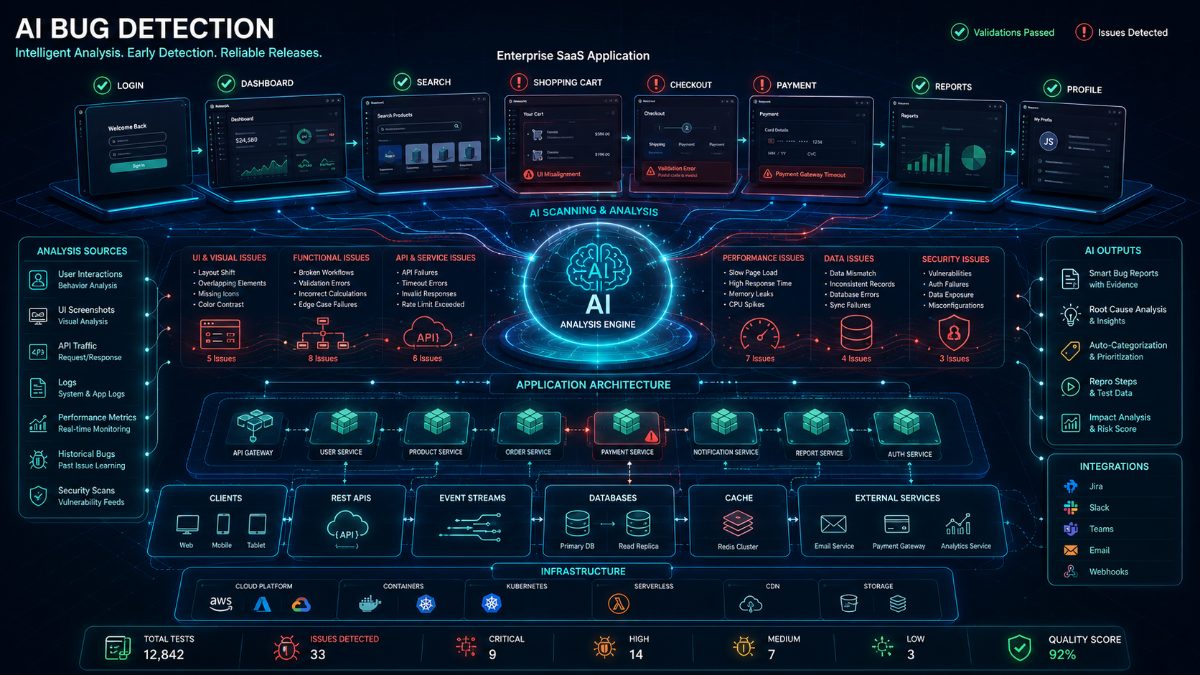
AI Bug Detection helps engineering teams automatically discover defects, identify abnormal application behavior, recognize UI inconsistencies, analyze failures, and prioritize issues before software reaches production.
Instead of simply executing test cases, AI actively looks for problems.
In this guide, we'll explore how AI Bug Detection works, why it's becoming essential for modern software teams, and how AI is helping organizations ship higher-quality software.
---
What Is AI Bug Detection?
AI Bug Detection is the use of artificial intelligence to automatically identify software defects by analyzing application behavior, user interactions, screenshots, logs, API responses, performance metrics, and historical failure patterns.
Unlike traditional automation, AI doesn't only verify predefined expected results.
It also learns what "normal" behavior looks like and identifies unexpected changes that could indicate bugs.
Its goal is straightforward:
Find defects earlier, faster, and with greater accuracy.
---
Why Traditional Bug Detection Is Difficult
Modern applications contain thousands of components.
A single user action may involve:
- Frontend UI
- Authentication service
- APIs
- Business logic
- Databases
- Payment providers
- Notification services
- Analytics
- Cloud infrastructure
Even a small code change can affect multiple systems simultaneously.
Traditional automated tests verify expected outcomes, but they may miss:
- Visual inconsistencies
- Unexpected workflows
- Slow responses
- Intermittent failures
- Broken integrations
- New edge cases
This is where AI provides an additional layer of intelligence.
---
How AI Detects Software Bugs
AI continuously analyzes information from multiple sources, including:
- Browser interactions
- UI screenshots
- Network requests
- API responses
- Performance metrics
- Console logs
- Error messages
- Historical defects
- User behavior
Instead of checking only predefined assertions, AI identifies unusual patterns and flags potential defects automatically.
For example:
If a checkout page suddenly takes 9 seconds instead of the usual 2 seconds, AI recognizes this anomaly even if functional tests still pass.
Similarly, if a button shifts position, overlaps another element, or disappears on mobile devices, AI can detect the visual regression without requiring new automation scripts.
---
Types of Bugs AI Can Detect
AI-powered testing platforms can identify a wide variety of issues, including:
- Functional defects
- Visual regressions
- UI alignment issues
- Broken workflows
- Missing elements
- API failures
- Performance degradation
- Security anomalies
- Accessibility issues
- Browser compatibility problems
The broader the application's telemetry, the more effective AI becomes.
---
Benefits of AI Bug Detection
Earlier Defect Discovery
AI identifies problems during development instead of after release.
---
Reduced Manual Investigation
Engineers spend less time reproducing bugs because AI collects screenshots, logs, timings, and execution details automatically.
---
Better Regression Testing
AI recognizes unexpected changes that traditional regression suites may overlook.
---
Higher Release Confidence
Development teams gain greater confidence before production deployments.
---
Faster Root Cause Analysis
Rather than reporting only that a test failed, AI helps explain why it failed.
---
Real-World Example
Imagine an online banking application introducing a new transaction history feature.
Traditional tests verify that transactions are displayed correctly.
However, AI also notices:
- Loading time increased by 45%
- Mobile layout shifted
- Search suggestions disappeared
- API latency doubled
- One browser displays incorrect formatting
- Accessibility contrast dropped below compliance standards
None of these issues required manually written assertions.
AI discovered them through behavioral analysis.
---
AI Does Not Replace Human Testers
AI excels at identifying anomalies, recognizing patterns, and processing enormous amounts of testing data.
But human QA engineers still provide:
- Business understanding
- Exploratory testing
- Risk assessment
- Customer empathy
- Product validation
The strongest testing teams combine human expertise with AI-powered insights.
---
Best Practices
- Run AI analysis during every CI/CD deployment.
- Review AI findings alongside manual testing.
- Keep historical defect data available for learning.
- Use AI to strengthen—not replace—regression testing.
- Continuously monitor production behavior.
---
Why This Matters for AI-Powered Testing
Modern software changes daily.
Traditional automation verifies expected behavior, but AI goes further by discovering unexpected behavior.
As applications continue growing in complexity, AI-powered bug detection will become one of the most valuable quality assurance capabilities available to engineering teams.
Organizations that adopt intelligent testing today will release software faster while delivering better customer experiences.
---
Why QA Teams Choose RoboQA
RoboQA combines AI-powered browser testing with intelligent bug detection.
Instead of only reporting failed test cases, RoboQA analyzes application behavior, captures screenshots, detects UI issues, validates APIs, monitors performance, and generates comprehensive bug reports automatically.
This allows QA teams to spend less time searching for problems and more time solving them.
---
Final Thoughts
Finding bugs before customers do has always been the goal of software testing.
Artificial Intelligence makes that goal far more achievable.
Rather than replacing testers, AI amplifies their ability to detect, investigate, and resolve defects quickly.
As software delivery accelerates, AI Bug Detection will become a standard capability for modern engineering organizations.
Teams that embrace intelligent testing today will build more reliable software tomorrow.
FAQ
Q. What is AI Bug Detection?
AI Bug Detection uses artificial intelligence to identify software defects by analyzing application behavior, screenshots, logs, APIs, and performance metrics.
Q. Can AI detect UI bugs?
Yes. AI can recognize visual regressions, layout changes, missing elements, and browser compatibility issues.
Q. Does AI replace manual testing?
No. AI complements QA engineers by automating defect discovery while humans continue validating business requirements and user experience.
Q. How does AI improve software quality?
AI discovers anomalies earlier, reduces manual investigation, improves regression testing, and increases release confidence.
Q. How does RoboQA help with AI Bug Detection?
RoboQA automatically executes browser workflows, detects defects, validates APIs, captures evidence, and generates AI-powered bug reports to accelerate software delivery.