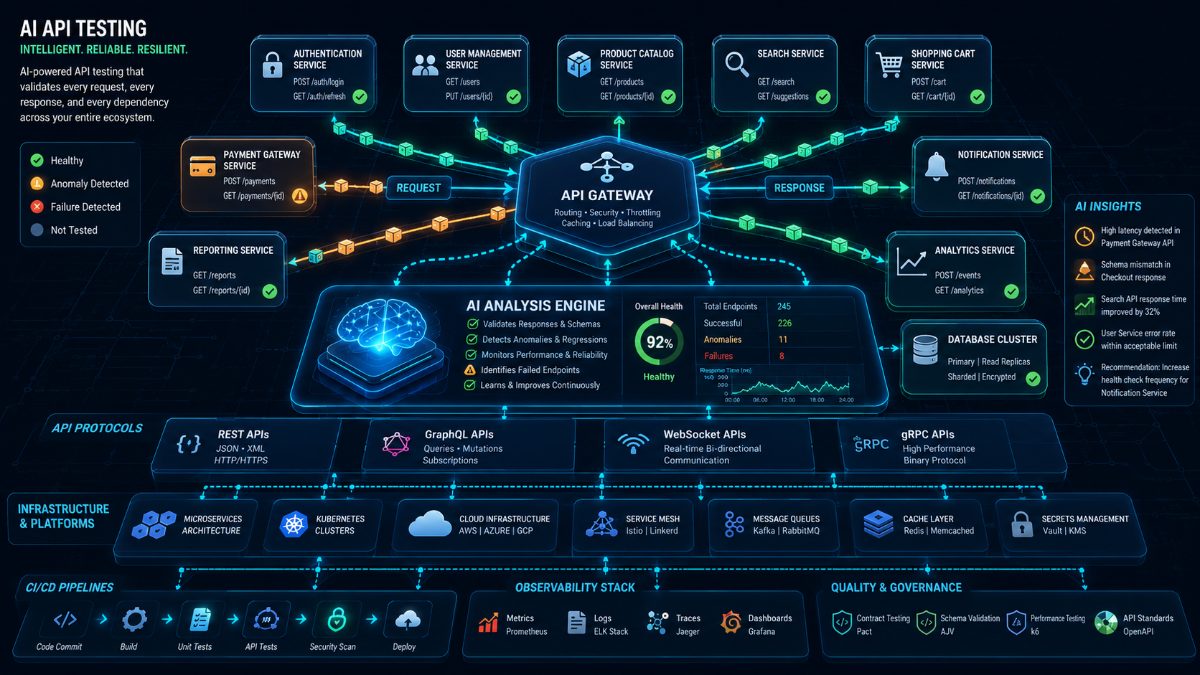
AI API Testing: The Complete Guide to Intelligent API Testing in 2026
Modern applications are powered by APIs.
Whether you're logging into an application, placing an online order, making a payment, searching products, or receiving notifications, APIs are constantly communicating behind the scenes.
As software becomes increasingly distributed through microservices and cloud-native architectures, API Testing has become one of the most important parts of Quality Assurance.
Artificial Intelligence is now transforming API Testing by making it faster, smarter, and significantly easier to maintain.
Instead of manually validating hundreds of endpoints after every release, AI can intelligently understand API behavior, generate test scenarios, detect anomalies, and continuously improve software quality.
In this guide, we'll explore how AI API Testing works and why it's becoming essential for modern engineering teams.
---
What is AI API Testing?
AI API Testing combines traditional API validation with Artificial Intelligence to automate endpoint testing, analyze responses, detect unusual behavior, generate intelligent test cases, and prioritize high-risk API workflows.
Instead of relying entirely on manually written API tests, AI assists QA engineers by understanding application behavior and recommending smarter validation strategies.
The result is faster feedback, better coverage, and higher confidence before deployment.
---
Why API Testing Matters
Today's applications are no longer monolithic.
A single user action may involve multiple services communicating simultaneously.
For example, placing an order may trigger:
- Authentication Service
- Product Catalog API
- Inventory Service
- Payment Gateway
- Order Management
- Email Notification
- Analytics Platform
- Shipping Provider
If even one API fails, the entire user experience can break.
That's why API Testing is critical.
---
Challenges of Traditional API Testing
Although API automation has improved software quality, teams still face several challenges:
- Thousands of endpoints
- Frequently changing schemas
- Authentication complexity
- Version management
- Large regression suites
- Manual test maintenance
- Limited edge-case coverage
These issues become more significant as engineering organizations scale.
---
How AI Improves API Testing
Artificial Intelligence enhances API Testing in multiple ways.
Intelligent Test Generation
AI analyzes API specifications and automatically generates meaningful test scenarios.
Smart Request Validation
Instead of validating only status codes, AI examines response consistency, business logic, and unexpected behaviors.
Risk-Based Testing
AI identifies APIs most likely to fail based on deployment history, previous defects, and recent code changes.
Anomaly Detection
Rather than checking only expected outputs, AI discovers unusual response patterns that traditional assertions may overlook.
Continuous Learning
Every execution helps AI improve future testing recommendations.
---
Benefits of AI API Testing
Faster Releases
Automated validation enables rapid deployment without sacrificing quality.
Better Coverage
AI explores additional combinations that manual testing often misses.
Lower Maintenance
Intelligent workflows adapt more effectively to API evolution.
Earlier Bug Detection
Issues are identified before they impact production systems.
Improved Developer Productivity
Developers receive actionable feedback immediately after deployment.
---
Real-World Example
Consider an online shopping platform.
When a customer completes checkout, several APIs execute together:
- User Authentication
- Product Availability
- Shopping Cart
- Discount Calculation
- Payment Processing
- Invoice Generation
- Order Confirmation
- Notification Service
Traditional API testing validates each endpoint separately.
AI also understands the complete business workflow and verifies how these services interact as one connected system.
---
Best Practices
- Integrate API Testing into CI/CD pipelines.
- Validate both functional and negative scenarios.
- Monitor response times continuously.
- Test authentication and authorization thoroughly.
- Combine AI insights with manual exploratory testing.
---
Why AI API Testing Matters
Modern software is built around APIs.
As applications become increasingly distributed, intelligent API Testing becomes essential for maintaining speed, reliability, and customer trust.
---
Why QA Teams Choose RoboQA
RoboQA combines AI-powered browser testing with intelligent API validation, helping engineering teams identify failures faster, automate repetitive testing, and release software with greater confidence.
---
💡 RoboQA Insight
Traditional API testing verifies expected responses.
AI API Testing goes one step further—it identifies unexpected behaviors before your customers experience them.
That's the difference between automation and intelligent quality engineering.
---
Final Thoughts
API Testing has become the backbone of modern software quality.
Artificial Intelligence doesn't replace API Testing—it makes it significantly more intelligent.
Teams that adopt AI-powered API Testing can reduce maintenance, increase test coverage, and accelerate software delivery without sacrificing reliability.